Integrated Playground Core Boards
Integrated Playground Core Boards: Why Communication Should Be Part of Play
Communication Belongs in the Playground, Not Just Beside It
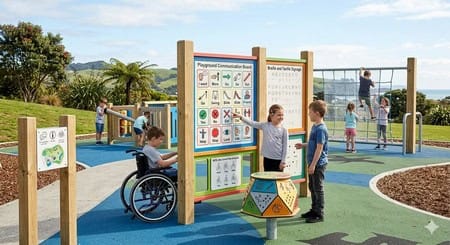
Why playground core boards should be integrated into play equipment
Core boards are an important communication tool for many children who are non-verbal, autistic, or have speech and language challenges. They provide a visual system of words, symbols, and prompts that help children express needs, make choices, interact with others, and participate more fully.
But there is a problem with how they are often used in playgrounds.
Too often, a core board is placed on the outer edge of the playground, almost like an extra sign added at the end of the project. While this may look inclusive on paper, it can fail in real life. Communication should not sit on the sidelines. It should be part of play itself.
The problem with periphery placement
When a core board is positioned away from the action, the child who needs it may have to leave the play moment in order to communicate. That creates a barrier.
A child climbing, waiting for a turn, choosing what to do next, asking for help, joining a game, or responding to another child may need communication support at that exact moment. If the board is across the playground, mounted on a fence line, or placed in a quiet corner, it is no longer part of the interaction. It becomes separate from the experience.
This can lead to several problems:
Communication is disconnected from play
Children need access to communication while they are playing, not before or after.
Inclusion becomes passive instead of active
A board placed on the edge may tick a box, but it does not create real participation.
Social opportunities are lost
Play is full of quick exchanges: my turn, your turn, help, stop, go, again, wait, look, together. If the communication tool is not close by, these natural moments can be missed.
The child may be isolated
Instead of communication happening alongside peers, the child may need to step away from the group to use the board.
Communication should be embedded into play
If we truly want inclusive playgrounds, communication supports need to be built into the places where children interact.
That means thinking beyond a single standalone board. It means asking:
Can a child communicate while climbing?
Can they point to symbols while waiting on a platform?
Can two children use the board together as part of the game?
Can the board support turn-taking, choice-making, and shared play in real time?
The goal should be to place communication where play happens.
Why this matters
For many children, communication is not separate from participation. It is participation.
A child who cannot easily speak may still want to say:
“I want a turn”.
“Again”.
“Help”.
“Stop”.
“Come with me”.
“Your turn”.
“I’m scared”
“Let’s go”.
“Fast”.
“More”.
These are not secondary needs. These are central to the playground experience.
When communication tools are integrated into the equipment itself, they become part of the social life of the playground. They help children connect with siblings, friends, parents, and other children. They also make communication more visible and normal for everyone.
Good inclusive design asks a better question
The question is not simply:
“Does this playground have a core board?”
The better question is:
“Can a child use communication supports while they are actively playing?”
That shift matters.
Real inclusion is not about placing helpful tools nearby. It is about making sure they are available in the moment, within the activity, and in the spaces where children naturally interact.
A better design approach
An integrated core board could be built into climbing equipment, activity panels, platform rails, playhouses, sensory pods, or other accessible play elements. It should be:
Within the play zone
Positioned where children already gather, pause, choose, and interact.
At child height
Easy to see and point to from seated or standing positions.
Durable and weather-resistant
Made from robust playground-grade materials with high contrast graphics.
Simple and relevant
Focused on real playground language such as go, stop, help, more, again, turn, climb, swing, slide, wait, friend, fast, slow, happy, scared.
Social by design
Placed where more than one child can use it together.
Communication is not an add-on
If a playground is meant to be a place where children play together, then communication must be treated as part of the equipment, not as an afterthought added around the edges.
A core board on the periphery may be better than nothing, but it is not the same as true inclusion.
Children should not have to leave play in order to communicate.
Communication belongs in the playground.