Powered Wheelchairs
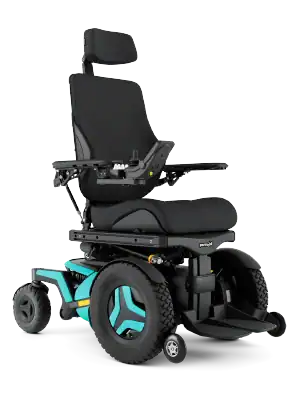
Why powered wheelchairs require a different design approach
Why This Matters
Powered wheelchairs change everything about how a space needs to be designed.
They are not just “another wheelchair”.
They are larger, heavier, and behave very differently in real-world use.
If a playground is designed around assumptions based on manual wheelchairs, it will fail powerchair users.
Inclusive design must recognise this from the start.
Powerchairs Are Bigger and Heavier
Powerchairs are built with motors, batteries, and reinforced frames.
Typical dimensions can include:
Wider bases
Longer overall length
Greater turning requirements
Standard powerchairs are often around 100–110 cm long and 60–65 cm wide, with significant variation depending on the model
They are not small devices.
They take up space, and they need space to move.
Weight Changes Everything
A powered wheelchair with a user can easily exceed:
200 kg total weight
And in many cases, significantly more
This weight cannot be:
Lifted
Shifted manually
“Bumped” over obstacles
If a powerchair gets stuck, it stays stuck.
Design must prevent that situation entirely.
Turning Is More Complex
Powerchairs do not turn like manual wheelchairs.
They require:
More space
More clearance
More planning
While some compact models have tight turning radii, others require much larger turning areas, depending on configuration
In real environments:
Turning is rarely perfect
Obstacles reduce usable space
Surface resistance increases effort
Minimum turning circles are often not enough.
Castor Wheels Create Risk
Most powerchairs use castor wheels at the front, rear, or both.
These wheels are:
Small
Load-bearing
Highly sensitive to edges
If a castor:
Drops off a path
Hits a lip
Catches on a surface change
The chair can stop instantly.
The user cannot simply push through.
Design must eliminate these risks.
Small Design Details Become Major Barriers
In real-world use, powerchairs are affected by:
Raised lips
Uneven surfaces
Gaps and joins
Loose materials
A small lip that may seem acceptable in design can completely stop a powerchair.
This is not an inconvenience.
It is a barrier.
Surface Choice Is Critical
Powerchairs require:
Firm surfaces
Consistent traction
Smooth transitions
Loose materials like bark or sand:
Increase resistance
Trap wheels
Make movement unpredictable
If the surface does not support movement, the equipment becomes unreachable.
Approach Space Matters
Powerchairs need space not just to move, but to position.
This includes:
Approaching equipment
Aligning correctly
Exiting safely
If there is not enough space:
The user cannot access the equipment
Cannot turn around
Cannot leave easily
Access is not just about getting there.
It is about using the space properly.
Design Must Support Independence
Powerchair users cannot rely on assistance for basic movement.
They must be able to:
Navigate independently
Turn without help
Position safely
If design requires assistance, it removes independence.
And independence is a core part of inclusion.
Real-World Movement Is Not Ideal
Design often assumes:
Clear paths
No obstacles
Perfect conditions
Real life is different.
Playgrounds are:
Busy
Dynamic
Unpredictable
Children run across paths
Surfaces wear over time
Space becomes limited
Design must work in these conditions, not just in theory.
The Problem With Minimum Standards
Minimum standards are often based on:
Average sizes
Ideal conditions
Simplified assumptions
Powerchairs often exceed these assumptions.
They are:
Larger
Heavier
Less forgiving
Designing to minimums creates risk.
Designing for real users creates inclusion.
Powerchairs Highlight Design Weakness
If a space works for a powerchair user, it will usually work for everyone.
If it fails a powerchair user, it likely fails many others, too.
Powerchairs expose:
Tight layouts
Poor transitions
Inadequate turning space
Unsafe surfaces
They are the true test of accessibility.
A Lived Experience Reality
From lived experience, the difference is immediate.
A space either:
Feels usable
Or feels restrictive
You either move freely
Or you start planning how to avoid getting stuck
That decision happens quickly.
And it determines whether the space is used at all.
Design for the Most Demanding Use Case
Inclusive design should not aim for “most users”.
It should aim for the users with the greatest needs.
Powerchair users represent one of the most demanding design cases.
If you design for them:
You design for everyone.
Final Thought
Powered wheelchairs are not an edge case.
They are a reality.
They are heavier, larger, and less forgiving of poor design.
A small lip can stop them.
A tight turn can trap them.
A poor surface can exclude them.
Inclusive design must respond to this.
Because if a powerchair user cannot use the space safely and independently, it is not inclusive.
It is incomplete.

Section 5 – Diagram set: Powerchair-friendly best practice
Diagram B: Powerchair-friendly picnic table layout (recommended)
This diagram shows a robust, real-world accessible design that works for most powered wheelchairs and outdoor conditions.
Diagram B – Labelled specifications
Purpose:
Show how to design for actual use, not just compliance.
Elements to draw:
Accessible picnic table
Same table as Diagram A for comparison
Primary turning area
Clear manoeuvring zone:
1800 mm × 1800 mm
Square or circular zone
Label: “Powerchair manoeuvring space”
Approach zone
Clear rectangle in front of the table:
800mm wide × 1400mm long
Label: “Powerchair approach and alignment zone”
Concrete pad
The pad extends beyond the turning and approach areas.
No edge drop-off at the table side
Label: “Extended hardstand for safe approach and exit”
Accessible path
Width: 1500 mm preferred
Direct, level connection
Label: “Accessible route – suitable for powered wheelchairs”
Edge treatment
If an edge exists, show a flush or ramped transition.
“No vertical drop-off”
This layout allows powered wheelchair users to approach, reposition, turn, and leave independently — even in wet conditions.

Section 6 – Common mistakes we see in playgrounds and parks
Common accessibility mistakes (and why they matter)
Mistake 1: Concrete pad too small
The wheelchair can reach the table, but cannot turn or exit safely.
Often requires reversing into grass.
Mistake 2: Grass or bark immediately around the pad
Becomes impassable when wet
Creates an invisible barrier
Mistake 3: Designing only for manual wheelchairs
Ignores powerchairs width, length, and turning needs
Excludes many users unintentionally
Mistake 4: Sharp pad edges
Small front casters drop off the edges.
Powerchairs cannot “bump” up easily.
Mistake 5: Treating accessibility as a tick-box
Results in facilities that look inclusive but aren’t usable
An amenity that requires assistance to use is not independently accessible.
Section 7 – Why getting it right the first time matters
Designing once is cheaper than retrofitting later
Fixing inaccessible outdoor amenities after installation is:
Expensive
Disruptive
Often avoided altogether
Designing properly from the outset:
Supports genuine inclusion
Works for a wider range of users
Reduces long-term costs
Reflects lived-experience design thinking
Inclusive design statement
This guidance is informed by real use of powered wheelchairs in outdoor environments, not just standards on paper.
Inclusive playgrounds and public spaces succeed when:
Powered wheelchair users are considered from the start.
surfaces are usable year-round
space is generous, not minimal
If a space can accommodate the largest wheelchair in the worst weather, it can accommodate everyone.

Inclusive World NZ Elections 2026 Project
Inclusive Play, Accessibility and the New Zealand Election 2026
Government and council decisions influence playground funding, accessibility standards, inclusive design and the development of public spaces that welcome disabled children and adults. Inclusive World New Zealand has created an Elections 2026 resource exploring the disability policies and public decisions that could shape more accessible communities across Aotearoa New Zealand.
Accessible Communities
Explore election issues involving accessible public spaces, housing, transport, community facilities and inclusive local infrastructure.
Explore Accessible CommunitiesDisabled Children and Inclusion
Learn about policies affecting disabled children, inclusive education, recreation, participation and equal opportunities within their communities.
View Issues Affecting Disabled ChildrenDisability Rights and Accountability
Read about disability rights, accessibility obligations, public consultation and the responsibility of governments and councils to remove barriers.
Explore Rights and AccountabilityPolitical Party Disability Policies
Follow political party commitments relating to disability, accessibility, community infrastructure and inclusion during the 2026 election campaign.
Compare Disability PoliciesVisit the complete Inclusive World NZ Elections 2026 Disability Hub for political party policies, disability legislation, community opinions, sector responses and election news affecting disabled New Zealanders.
Visit the Elections 2026 Disability Hub