Inclusive Play Beyond Equipment
Inclusive Play Beyond Equipment
Why This Matters
Inclusive playgrounds are often judged by what is installed.
Swings, slides, panels, and structures.
But inclusion is not created by equipment alone.
It is created by the entire environment and how people experience it.
Because a playground can have inclusive equipment and still exclude people.
Inclusion Is About the Whole Experience
True inclusion goes beyond access to equipment.
It includes:
How people arrive
How they move
How they feel
How they interact
Inclusive design is about creating environments that are usable by as many people as possible, not just adding features.
If any part of the experience fails, inclusion fails.
Accessibility Is Only the Starting Point
Accessibility allows entry.
Inclusion allows participation.
Guidance shows that accessible features like ramps and pathways are just the foundation; real inclusion comes from how the space is designed and experienced.
A playground can be accessible.
The Environment Shapes Behaviour
Children do not interact with equipment in isolation.
They respond to:
Layout
Flow
Surfaces
Social spaces
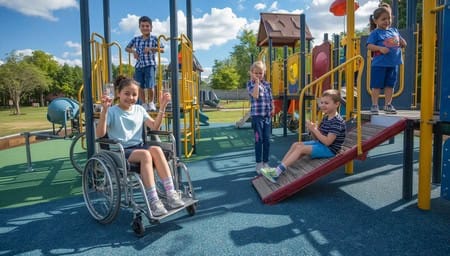
Research shows that inclusive play environments must remove physical, sensory, and social barriers to allow participation for all children
This means the design must focus on the whole system.
Not just individual items.
Movement Through the Space Matters
Inclusion depends on movement.
This includes:
Getting from the parking to the playground
Moving between play areas
Reaching equipment easily
If movement is difficult:
People cannot participate
They avoid the space
They leave early
The journey matters as much as the destination.
Social Interaction Is Designed — Not Added
Playgrounds are social environments.
But social interaction does not happen automatically.
It must be designed.
This includes:
Shared play spaces
Face-to-face opportunities
Group equipment
Inclusive design creates spaces where children can interact and play together rather than separately.
If children are separated, inclusion is lost.
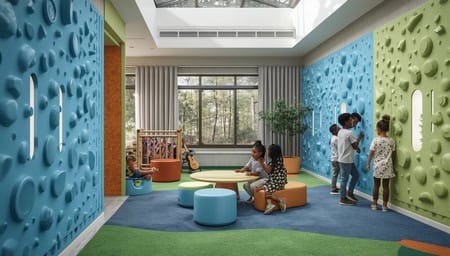
Sensory Experience Shapes Participation
Play is sensory.
Children respond to:
Movement
Sound
Texture
Visual input
Design guidance highlights the importance of providing multi-sensory experiences and quiet spaces to support different needs.
If a playground overwhelms or under-stimulates, children disengage.
Comfort and Confidence Matter
Caregivers and families make decisions based on how a space feels.
They look for:
Safety
Visibility
Ease of use
Comfort
If a space feels:
Confusing
Unsafe
Difficult
They leave.
Inclusion only works when people feel confident.
Facilities Are Part of Inclusion
Inclusion extends beyond play equipment.
It includes:
Accessible toilets
Seating and rest areas
Shade and shelter
Drinking water
These are not extras.
They determine how long people can stay.
And whether they return.
Design for All Ages and Abilities
Inclusive playgrounds are not just for children.
They must support:
Caregivers
Siblings
Older adults
People with different needs
Inclusive design considers a wide range of physical, cognitive, and sensory abilities.
Because play spaces are community spaces.
Choice Creates Inclusion
Children need options.
This includes:
Active play
Quiet play
Social play
Independent play
Providing choice allows children to engage in ways that suit them.
Without choice, participation is limited.
If the Environment Fails, the equipment cannot Fix It
You can install:
Accessible swings
Inclusive seesaws
Sensory panels
But if:
The surface is inaccessible
The layout is confusing
The space feels unsafe
The equipment will not be used.
Equipment cannot fix a poorly designed environment.
Real-World Use Is the True Test
In real playgrounds:
People do not analyse design
They experience it
They decide quickly:
Can I move easily?
Can my child play safely?
Do I feel comfortable here?
If the answer is no, they leave.
A Lived Experience Reality
From lived experience, inclusion is obvious.
A space either:
Works as a whole
Or fails in parts
And those parts matter.
Because one barrier is enough to stop participation.
Beyond Compliance — Towards Real Inclusion
Designing beyond equipment means moving beyond:
Minimum standards
Checklist thinking
Token features
It means designing for:
Real people
Real behaviour
Real use
Because inclusion is not a box to tick.
It is an outcome to achieve.
Final Thought
Inclusive play is not created by equipment alone.
It is created by the environment as a whole.
From arrival to departure
From movement to interaction
From safety to confidence
Because if the space does not work as a whole, it does not work at all.
And inclusion is not about what is installed.
It is about whether people can truly take part.