Wheelchair Accessible Seesaws
Wheelchair Accessible Seesaws
Why This Matters
A traditional seesaw is one of the most recognisable pieces of playground equipment.
But for many children, it is completely unusable.
If a child cannot get onto the equipment, they cannot take part.
Inclusive design must rethink the seesaw so everyone can play together — not separately.
The Problem With Traditional Seesaws
Standard seesaws rely on:
Climbing on
Balancing without support
Using legs to push
This immediately excludes:
Wheelchair users
Children with limited mobility
Children who need support to sit
Traditional designs were never built for inclusion.
They were built for one type of user.
Inclusive Seesaws Change the Experience
Wheelchair-accessible seesaws are designed differently.
They allow:
Roll-on access from ground level
Shared use with other children
Safe, controlled movement
Modern designs feature ramps or tilting bases to make entry easy and safe.
This is not an adaptation.
It is a redesign.
Designed for Shared Play
Inclusive seesaws are not just for wheelchair users.
They are designed so:
Children of all abilities can play together
Multiple users can participate at once
Social interaction happens naturally
Some designs allow wheelchair users and other children to ride together in the same activity.
This removes separation.
It creates real inclusion.
Movement Still Matters
A seesaw is about movement.
Inclusive designs maintain that experience through:
Gentle rocking motion
Controlled balance
Predictable movement
This provides:
Vestibular input
Sensory feedback
Physical engagement
Children are not just included.
They are part of the same experience.
Safety Is Built Into the Design
Inclusive seesaws must handle:
Higher weights
Different body positions
Dynamic movement
This includes:
Wheelchairs and users (often over 200 kg combined)
Multiple riders
Uneven weight distribution
Modern designs use strong materials, stable platforms, and controlled movement systems to ensure safety.
Safety is not an add-on.
It is engineered into the equipment.
Entry and Exit Must Be Easy
Access is one of the most important design factors.
Inclusive seesaws must allow:
Easy roll-on entry
Safe positioning
Simple exit
If a child cannot get on independently, the equipment fails.
Access must be:
Clear
Level
Unobstructed
Balance and Counterweight Design
Traditional seesaws rely on equal weight.
Inclusive seesaws must work differently.
They are designed to:
Handle uneven loads
Provide assisted balance
Prevent sudden drops
Some use spring systems or dampened movement to ensure a smooth and controlled experience.
This reduces risk and increases confidence.
Space Around the Equipment Matters
A seesaw does not exist in isolation.
It requires:
Clear approach space
Turning space for wheelchairs
Safe circulation around it
If a user cannot:
Approach
Position
Exit
Then the equipment cannot be used.
Access is about the whole area, not just the item.
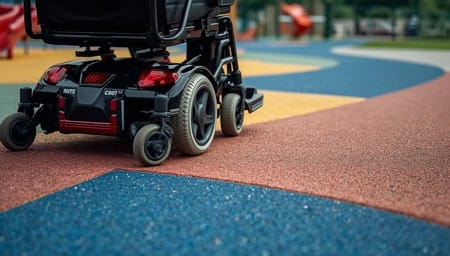
Surface Is Critical
The surface leading to the seesaw must be:
Firm
Stable
Level
Loose surfaces like bark or sand:
Prevent access
Create resistance
Stop movement
If a wheelchair cannot reach the seesaw, the design has failed before play begins.
If It Feels Unsafe, It Will Not Be Used
Caregivers make quick decisions.
They look at equipment and ask:
Is this safe?
Can my child use this?
If the answer is uncertain, they walk away.
This is why:
Stability matters
Predictability matters
Design matters
Inclusivity only works when people feel safe.
The Problem With “Cheaper” Seesaws
Lower-cost designs often:
Reduce stability
Limit usability
Increase risk
They may technically be accessible.
But in real use:
They feel unsafe
They are difficult to use
They are avoided
This is why accessible equipment is often underused.
Not because it is not needed.
But it is not designed properly.
If It’s Not Used, It’s Not Inclusive
We often hear:
“The accessible seesaw is not being used.”
The real reason is usually:
It is hard to access
It feels unsafe
It does not work in real conditions
Use is the only true measure of inclusion.
Real-World Impact
When designed properly, accessible seesaws change everything.
They allow children who previously watched from the sidelines to:
Join in
Interact
Feel included
A wheelchair-accessible seesaw installed in Whangārei gave children with disabilities the chance to play rather than just watch.
That is the difference.
A Lived Experience Reality
From lived experience, the difference is immediate.
A seesaw either:
Feels safe and usable
Or feels risky and difficult
A child either:
Gets on
Or stays off
That decision happens instantly.
Design for Inclusion — Not Appearance
Adding a seesaw is not enough.
It must be:
Accessible
Safe
Usable in real life
Otherwise, it becomes equipment that looks inclusive but is not used.
Final Thought
A wheelchair-accessible seesaw is more than equipment.
It is a statement.
It says:
You belong here
You can play here
You are part of this space
Because inclusion is not about installing something different.
It is about making sure everyone can take part together.