What to Ask Playground Suppliers
What to Ask Playground Suppliers
Choosing the Right Playground Supplier
Choosing the right playground supplier is about far more than price or colourful brochures. The questions asked at the beginning of a project often determine whether a playground becomes genuinely inclusive or simply appears inclusive on paper. Many communities spend large amounts of money on equipment that technically meets standards but still creates barriers for disabled children and families in real-world use.
A good supplier should be willing to discuss accessibility openly and in practical terms, not just provide generic claims about inclusion.
Experience With Inclusive Design
One of the most important questions to ask is whether the supplier has genuine experience designing inclusive playgrounds for a wide range of disabilities. Accessibility is not only about wheelchair users. Inclusive design should also consider autistic children, sensory processing differences, visual impairments, hearing impairments, mobility challenges, intellectual disabilities, and the needs of carers and families.
Suppliers should be able to explain how their designs support independence, participation, communication, regulation, comfort, and social interaction.
Accessibility Beyond Compliance
A playground can technically comply with standards while still being difficult or impossible for many disabled children to use. Ask suppliers how children actually move through the space, how wheelchairs access equipment, how pathways connect together, and whether circulation spaces allow independent movement.
Real-world usability matters more than marketing language or compliance checklists.
Questions About Surfacing
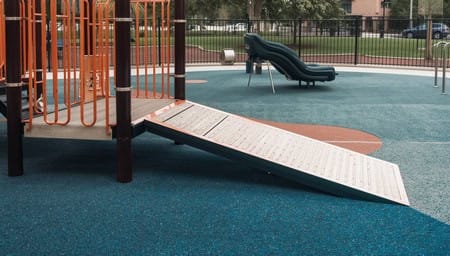
Surfacing is one of the biggest accessibility issues in playground design. Many playgrounds install accessible equipment but surround it with bark, loose fill, raised edges, or uneven transitions that stop wheelchair users from accessing most of the site.
Ask suppliers:
What surfacing options are recommended?
How does the surfacing perform over time?
Can wheelchairs, walkers, and mobility scooters move independently across it?
Are transitions smooth and continuous?
Does the surfacing remain accessible after years of use?
Accessibility should extend across the whole playground, not stop at a single feature.
Designing for Families and Carers
Inclusive playgrounds should work for entire families. Ask suppliers how the design supports supervision, rest, shelter, seating, accessible toilets, picnic areas, and quiet retreat spaces.
Carers often need clear sightlines, comfortable seating, shade, and nearby amenities. Families with disabled children frequently stay longer when these needs are considered properly.
Maintenance and Long-Term Usability
Accessibility can disappear quickly when maintenance is neglected. Ask suppliers how repairs are handled, how long replacement parts take to arrive, and how surfacing performs over time.
Inclusive playgrounds should remain usable years after installation, not just on opening day.
Lived Experience Matters
Ask whether the supplier consults with disabled people, disability advocates, therapists, educators, or families with lived experience. Technical guidelines alone do not always identify real-world barriers.
People who use mobility devices, communication supports, sensory tools, or adaptive equipment every day often notice problems others miss.
Visit Existing Projects
Request examples of previous playgrounds and, if possible, visit them. Real-world observation is one of the best ways to evaluate accessibility.
Look carefully at:
Pathway connections
Surfacing transitions
Wheelchair circulation space
Seating and shelter
Shade and comfort
Signage and navigation
Accessibility between equipment
How children and families actually use the space
Often, the difference between “accessible” and “truly inclusive” becomes obvious once you see the playground in person.
Creating Better Community Spaces
Inclusive playgrounds are long-term community assets. Asking better questions early can help councils, schools, and community groups avoid costly mistakes and create spaces where more children, adults, carers, and families genuinely feel welcome, included, and able to participate together.