Designing for Hard of Hearing Users
Designing for Hard of Hearing Users
Designing for Hard of Hearing Users
Why This Matters
Not all children hear the playground in the same way.
Some hear partially. Some rely on hearing aids or cochlear implants. Some rely more on visual information than sound.
If a playground depends on hearing to understand what is happening, it creates barriers.
Inclusive design must ensure that children who are hard of hearing can navigate, communicate, and play with confidence.
Hearing Is Not the Only Way to Understand
Many playgrounds rely heavily on sound.
Calling out
Listening for instructions
Responding to verbal cues
But children who are hard of hearing may:
Miss information
Misinterpret cues
Rely on other ways to understand
Design must not depend on sound alone.
It must offer other ways to communicate and interact.
Visual Connection Is Critical
Children who are hard of hearing rely heavily on what they can see.
This includes:
Watching others
Seeing facial expressions
Reading body language
Following movement
Design guidance highlights that clear visual connections between spaces support communication and interaction for deaf and hard of hearing children.
If sightlines are blocked, communication breaks down.
Face-to-Face Interaction Supports Communication
Many children who are hard of hearing use:
Lip reading
Facial cues
Sign language
Playground design should support:
Face-to-face positioning
Side-by-side interaction
Open seating arrangements
Research shows that face-to-face layouts help support communication and social play without relying on sound.
If children cannot see each other clearly, interaction becomes harder.
Play Should Not Depend on Hearing Instructions
Some equipment requires explanation.
“Push here”
“Wait for the signal”
“Listen for your turn”
This creates barriers.
Inclusive design should:
Show how the equipment works
Allow intuitive use
Reduce the need for instruction.
If a child needs instructions to participate, the design limits them.
Movement and Play as Communication
Play itself becomes communication.
Children interact through:
Movement
Timing
Shared activity
Swings, seesaws, and group equipment allow children to:
Respond to each other
Create rhythm
Engage socially
These interactions do not require sound.
They create connections through action.
Use Visual Cues and Signals
Visual communication should be built into the environment.
This includes:
Clear pathways
Visible entry points
Colour-coded zones
Symbols and markings
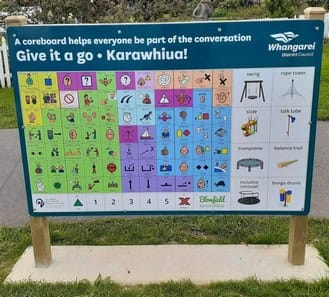
Design guidance recommends using visual communication, symbols, and colour to support understanding and navigation.
These cues reduce reliance on hearing.
Vibration and Tactile Feedback
Sound can be replaced with other sensory input.
For example:
Drums that can be felt
Platforms that vibrate
Equipment that provides physical feedback
Research shows that vibration and tactile elements help children who are hard of hearing experience play in a different but equally meaningful way.
This creates inclusive multi-sensory play.
Avoid Over-Reliance on Audio Features
Some playgrounds include:
Musical panels
Sound-based games
Audio cues
These can be valuable, but they should not be the only option.
If interaction depends on sound, some children are excluded.
Inclusive design always provides alternatives.
Safety Through Visibility
Children who are hard of hearing may not hear warnings.
They may not hear:
A child approaching
A caregiver calling
A potential hazard
This makes visibility even more important.
Design should ensure:
Clear sightlines
Open layouts
No hidden areas
Safety must not rely on sound.
Support Confidence and Independence
Children need to feel confident using the space.
If they:
Miss information
Feel unsure
Cannot follow what others are doing
They may withdraw.
Inclusive design supports:
Clarity
Predictability
Ease of understanding
Confidence comes from knowing what is happening.
Social Inclusion Matters
Playgrounds are social spaces.
Children who are hard of hearing should be able to:
Join in easily
Interact with others
Be part of the group
Research indicates that inclusive playgrounds must support social interaction without relying solely on verbal communication.
If interaction depends on hearing, inclusion is limited.
Real-World Behaviour
In real playgrounds:
Children do not wait for explanations
They do not ask for instructions
They join in by watching and copying
Design must support this.
If understanding depends on hearing, some children are left out.
A Lived Experience Reality
From lived experience, the difference is immediate.
A space either:
Feels easy to understand
Or feels confusing
A child either:
Joins in or stands back
That decision happens quickly.
Design determines the outcome.
Final Thought
Designing for hard of hearing users is not about adding features.
It is about removing reliance on sound.
When playgrounds support visual communication, movement, and shared interaction, children can participate fully.
When they rely on hearing, they exclude.
Because inclusion is not about how children hear.
It is about whether they can connect.