Drinking Fountains & Water Access
Drinking Fountains & Water Access
Why Water Access Matters in Inclusive Playgrounds
Access to drinking water is a basic human need.
In playgrounds, it is also part of participation.
Children run, play, climb, and explore. Families stay longer when spaces are comfortable and supportive. Without access to water, visits are cut short, dehydration becomes a risk, and inclusion is reduced.
For disabled children and adults, accessible drinking fountains are not a convenience; they are essential.
Inclusive playground design must include safe, reliable, and accessible access to drinking water for everyone.
Accessibility Is About Reach, Height, and Space
A drinking fountain is only accessible if it can actually be used.
This means:
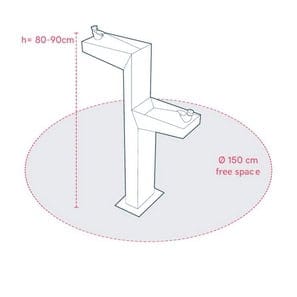
The height must suit wheelchair users
There must be space underneath for knees and footrests
Controls must be reachable from a seated position
The user must be able to approach the fountain without obstruction
Many public fountains are installed at a single height, which excludes children and wheelchair users. Modern inclusive design often uses dual-height fountains or designs specifically intended for wheelchair access.
If a person cannot reach the water, the fountain does not exist for them.
Approach and Clear Space Matter
Getting to the fountain is just as important as the fountain itself.
The surrounding space must allow:
A clear approach path
Room to position a wheelchair or mobility device
Enough space to turn and leave safely
If the path is narrow, uneven, or blocked, the fountain becomes unusable.
As with all inclusive design, the space around the feature is just as important as the feature itself.
Design for Different Users, Not Just One
Inclusive drinking fountains should work for:
Wheelchair users
Powerchair users
Children
Adults
People of different heights
People with limited strength or dexterity
This is why many public fountains now include:
Dual heights
Bottle filling stations
Easy push-button or sensor controls
Designing for a range of users improves access for everyone.
Controls Must Be Simple and Reachable
Operating a drinking fountain should not require strength, precision, or awkward movement.
Controls should be:
Easy to press or activate
Positioned within reach from a seated position
Usable with one hand
Push-button systems, timed flow, and sensor-activated systems are commonly used to improve usability and hygiene.
If the control is difficult to use, the fountain becomes a barrier.
Water Flow and Basin Design
The way water flows matters.
A good fountain design should:
Minimise splashing
Allow easy drinking without awkward positioning
Provide a clear, consistent stream
Deep basins and angled spouts help reduce splash and improve usability, particularly for wheelchair users.
Poor design can make drinking difficult, messy, or unsafe.
Location Within the Playground
Drinking fountains should be placed where people actually need them.
They should be:
Close to play areas
Located along accessible pathways
Near seating, shade, and rest areas
Easy to find
If a fountain is hidden, too far away, or disconnected from the main play space, it will not be used.
Water access should feel like a natural part of the playground.
Safety Around Water Points
The area around a drinking fountain must be safe.
This includes:
Slip-resistant surfaces
Good drainage to prevent pooling water
Clear space to avoid congestion
Well-designed fountains include drainage systems or grates to keep the surrounding areas dry and safe.
Water should never create a hazard.
Bottle Fillers and Modern Use
Many users now carry drink bottles.
Including bottle filling stations alongside fountains:
Reduces plastic waste
Supports longer visits
Improves usability for all ages
Modern public fountains often integrate bottle fillers as a standard feature in schools, parks, and public spaces.
This small addition has a big impact.
Durability and Maintenance
Drinking fountains must be built for public use.
They need to be:
Durable
Vandal-resistant
Easy to clean
Easy to maintain
Materials such as stainless steel and protected components help ensure long-term usability in outdoor environments.
A broken or poorly maintained fountain is no fountain at all.
Common Mistakes
Drinking fountains often fail due to simple design issues.
Installed at the wrong height
No space for wheelchair access
Poor drainage causing slippery surfaces
Located off accessible paths
Controls too hard to use
No bottle filling option
Poor maintenance
These are not small issues. They directly affect whether people can use the space.
A Lived Experience View
From lived experience, something as simple as getting a drink can become difficult or impossible.
If the fountain is too high, too low, too far away, or blocked by poor design, the disabled person is the one who has to adapt.
They may need assistance. They may go without. They may leave early.
Good design removes that barrier.
Accessible water access allows people to stay longer, feel comfortable, and fully participate.
Final Thought
Inclusive playgrounds are built on small details done well.
Drinking fountains are one of those details.
When designed properly, they support health, comfort, and independence.
When overlooked, they quietly exclude people.
Access to water should never be a barrier.
It should be available to everyone, without effort, without assistance, and without compromise.