Visual Communication in Play Spaces
Visual Communication in Play Spaces
Why Visual Communication Matters
Not everyone communicates with words.
On playgrounds, many children rely on what they can see rather than what they can hear or read.
Visual communication allows children to understand, interact, and participate without needing spoken language.
If a playground depends on verbal instruction, it excludes.
If it communicates visually, it includes.
What Visual Communication Really Is
Visual communication is the use of images, symbols, colour, and layout to share information.
It allows people to understand meaning through what they see, rather than what they are told
In a playground, this means:
Understanding how to use equipment
Knowing where to go
Recognising how to join in
Without needing explanation.
Playgrounds Must Communicate Without Words
Children do not arrive with instructions.
They explore, observe, and learn through what they see.
A well-designed playground should:
Show how the equipment works
Make movement obvious
Allow children to copy and join
If a child has to ask, “How do I use this?”, the design is already failing.
Visual Cues Guide Behaviour
Good design uses visual cues to guide interaction.
This includes:
Clear pathways
Visible entry points
Obvious play positions
Research shows that inclusive play spaces rely on perceptible information communicating effectively regardless of sensory ability.
Visual clarity reduces hesitation.
It invites participation.
Colour and Contrast Support Understanding
Colour is not just decoration.
It is information.
Visual contrast helps children:
Identify edges
Recognise pathways
Differentiate play areas
Design guidance highlights that contrast and colour help users, including those with vision impairments, understand and navigate spaces.
Without contrast, spaces blur together.
With it, they become readable.
Communication Boards and Visual Tools
Some children need structured visual support.
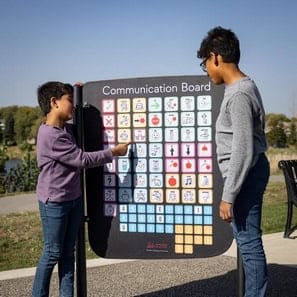
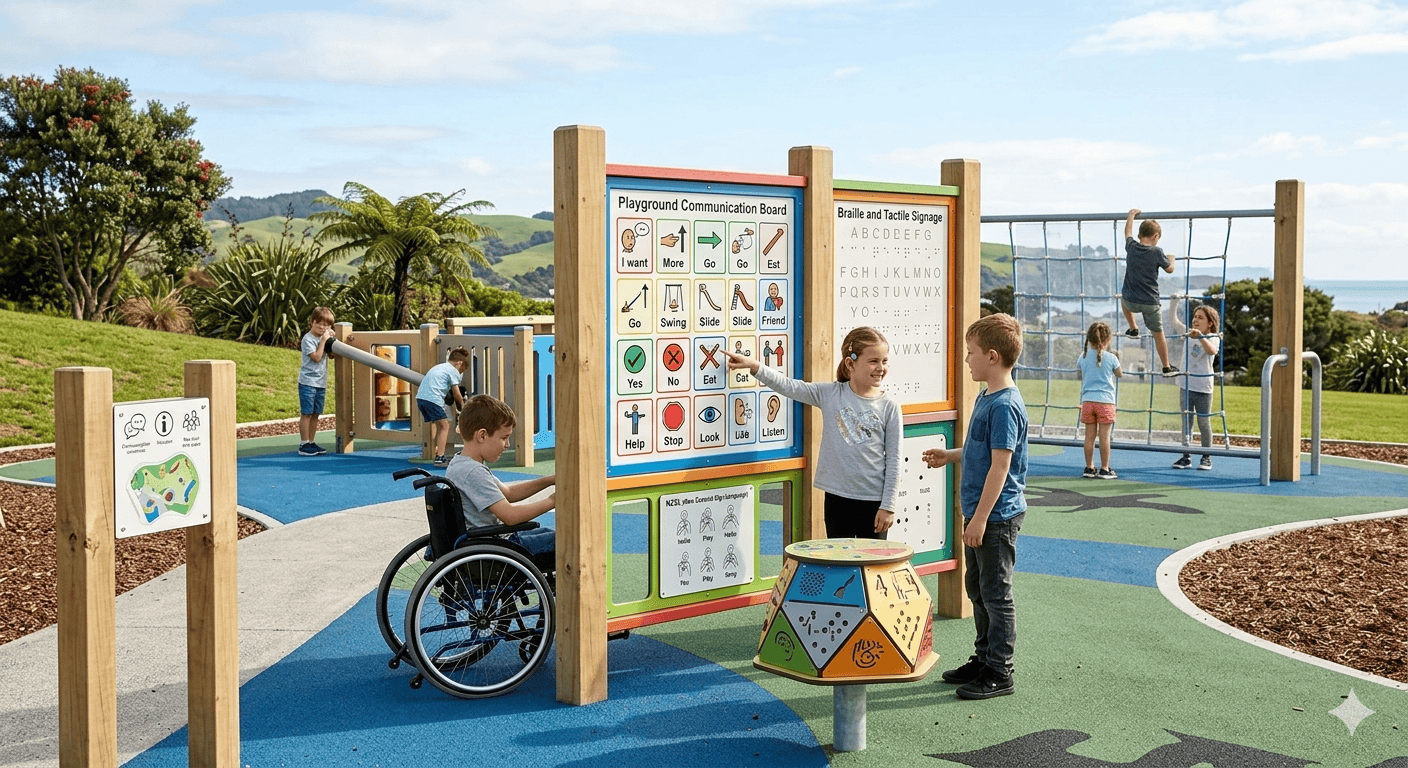
Communication boards provide:
Symbols
Images
Words
These allow children to:
Express needs
Make choices
Interact with others
Research shows that visual communication displays in playgrounds support choice, expression, and social connection.
These tools are not extras.
They are essential for many users.
Visual Communication Supports Social Play
Play is social even without speech.
Visual communication allows children to:
Watch and copy others
Understand shared activities
Join in without asking
Communication boards and visual tools also support interaction by giving children alternative ways to communicate and engage.
Play becomes the language.
Design Should Show, Not Tell
Inclusive playgrounds reduce the need for instruction.
They do this by:
Making use obvious
Designing intuitive interactions
Using layout to guide behaviour
If a child needs instructions, the design is too complex.
If they can understand it instantly, the design is working.
Support Different Ways of Understanding
Not all children process information the same way.
Some rely on:
Visual cues
Repetition
Observation
Routine
Inclusive design recognises this diversity and ensures spaces are usable for a wide range of abilities.
There is no single way to communicate.
Design must support many.
Visibility Creates Inclusion
Children need to see what is happening.
They need to:
See other children play
See how the equipment moves
See where they can go
Design guidance highlights the importance of visibility and visual connection to support interaction and understanding.
If children cannot see what is happening, they cannot join in.
Avoid Over-Complex Visual Design
More visual information is not always better.
Too much can create confusion.
Good visual design is:
Clear
Simple
Consistent
It should reduce effort, not increase it.
Layout Is Visual Communication
The layout of a playground is one of the strongest communication tools.
It tells people:
Where to go
Where to stop
Where to play
A clear layout removes the need for signs.
A confusing layout creates barriers.
Real-World Behaviour
In real playgrounds:
Children do not read signs
They do not follow instructions
They do not wait for an explanation
They look.
They copy.
They join.
Design must support this natural behaviour.
A Lived Experience Reality
From lived experience, visual communication is immediate.
You either understand the space, or you don’t.
You either see how to join in, or you stay back.
That moment decides everything.
Final Thought
Visual communication is one of the most powerful tools in inclusive design.
It allows children to understand, connect, and participate without relying on words.
When playgrounds communicate visually, they become easier, safer, and more inclusive.
Because inclusion is not about how information is given.
It is about whether it is understood.