NZ Accessibility Guidance
NZ Accessibility Guidance
Accessibility in New Zealand is often discussed through standards, building codes, compliance documents, and technical guidelines.
These documents are important.
They provide a framework for improving access and reducing barriers within public spaces and buildings.
But there is also an important reality that needs to be acknowledged:
Compliance alone does not automatically create true inclusion.
A space may technically meet standards while still being difficult, stressful, or impossible for many disabled people and families to use comfortably in real life.
That is why lived experience matters.
Accessibility Is About Participation
Good accessibility is not simply about whether somebody can physically enter a space.
True accessibility is about whether people can:
Participate independently
Move safely
Interact socially
Navigate confidently
Feel welcomed
Use facilities with dignity
Belong within their community
This applies to:
Playgrounds
Pathways
Parks
Buildings
Toilets
Parking areas
Sensory spaces
Public facilities
Accessibility should be viewed as part of community participation, not just a compliance requirement.
New Zealand Accessibility Standards
New Zealand accessibility guidance is primarily linked to:
The Building Act 2004
Building Code Clause D1 Access Routes
NZS 4121:2001 Design for Access and Mobility
Associated accessibility Guidance documents and acceptable solutions (Building Performance).
These standards provide guidance on:
Accessible routes
Ramps and gradients
Circulation space
Mobility parking
Door widths
Manoeuvring clearances
Accessible toilets
Signage
Surfacing
Safety requirements
They form an important baseline for accessibility design within New Zealand.
Accessibility Standards Continue to Evolve
One important issue is that accessibility standards continue to evolve as understanding improves.
Whaikaha and Standards New Zealand are currently reviewing NZS 4121 because many aspects no longer fully reflect modern accessibility expectations, technologies, and neurodiverse access needs (whaikaha.govt.nz).
Historically, accessibility guidance focused heavily on physical mobility and wheelchair access.
Modern inclusive design now increasingly considers:
Sensory accessibility
Autism-friendly environments
Neurodiverse users
Low vision users
Cognitive accessibility
Emotional regulation
Social participation
Inclusive communication
Accessibility is broader than physical movement alone.
Accessible on Paper vs Accessible in Real Life
One of the biggest issues we repeatedly encounter is the difference between technical compliance and real-world usability.
A playground or public space may technically comply with standards while still creating barriers through:
Bark surfacing
Trapped castors
Poor manoeuvring space
Inaccessible transitions
Sensory overload
Excessive gradients
Poor visibility
Confusing layouts
Inaccessible social spaces
Something can look accessible in a concept drawing while functioning very differently in practice.
That is why lived experience should always be part of accessibility planning.
Accessibility Is More Than Wheelchairs
Accessibility conversations are often reduced to wheelchair ramps alone.
But real inclusion also affects:
Autistic children
ADHD children
Low vision users
Blind users
Deaf users
Elderly visitors
Neurodiverse families
People using walkers or mobility aids
Parents with strollers
Carers and support workers
Inclusive public spaces should recognise the wide diversity of people using them.
Accessible Routes Matter
The New Zealand Building Code places strong emphasis on accessible routes and circulation (Building Performance).
Accessible routes should provide:
Stable surfaces
Predictable movement
Safe gradients
Adequate width
Clear circulation
Manoeuvring space
Safe transitions
Good visibility
In playground environments, accessible routes should connect:
Parking areas
Toilets
Seating zones
Play equipment
Pathways
Gathering spaces
Family areas
Accessibility should feel continuous throughout the environment.
Surfacing Is One of the Biggest Issues
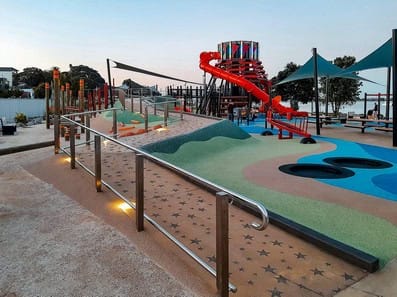
Surfacing remains one of the most overlooked accessibility barriers in New Zealand playgrounds.
Loose-fill bark is commonly used because it reduces upfront project costs.
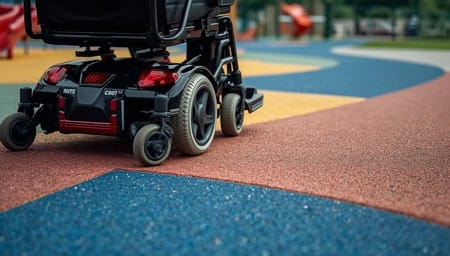
However, bark often creates major real-world problems for:
Wheelchair users
Walking frame users
Powerchair users
Parents with strollers
Elderly carers
Neurodiverse children with balance/sensory challenges
Bark shifts, forms ruts, traps wheels, creates uneven surfaces, and reduces independence.
Accessible surfacing systems provide:
Smoother movement
Safer circulation
Better manoeuvrability
Reduced fatigue
Greater confidence and independence
The surface around equipment is just as important as the equipment itself.
Manoeuvring Space Matters
Many accessibility problems occur because spaces are designed around minimum dimensions rather than real-world use.
Wheelchairs, powerchairs, mobility scooters, and support equipment often require:
Larger turning circles
Transfer space
Side access zones
Circulation room for carers and families
Good inclusive design should consider how people actually move through a space, not just whether minimum dimensions have been technically met.
Inclusion Requires Lived Experience
Accessibility standards are important.
But disabled people and families often identify practical barriers that compliance documents alone cannot fully capture.
Lived experience helps identify:
Trapped wheels
Unsafe transitions
Sensory overload
Inaccessible layouts
Poor visibility
Fatigue issues
Social barriers
Dignity concerns
This is why meaningful consultation with disabled people should always be part of inclusive playground and public space design.
Good Accessibility Benefits Everybody
Inclusive design rarely benefits only disabled people.
Good accessibility often creates better outcomes for:
Families with young children
Elderly visitors
Temporary injuries
Delivery access
Community events
Parents with strollers
Wider public usability
Accessible communities are stronger communities.
Accessibility Should Feel Natural
The best accessible spaces are often the ones that feel effortless.
Children and families should not need to constantly:
Ask for help
Navigate barriers
Search for access routes
Struggle through unsuitable surfaces
Feel excluded from participation
Good inclusive design creates environments where people feel:
Welcomed
Independent
Safe
Respected
Included within community life
Because accessibility is not simply about meeting minimum standards.
It is about creating spaces where people can genuinely participate, belong, and feel accepted.
Inclusive World NZ Elections 2026 Project
Inclusive Play, Accessibility and the New Zealand Election 2026
Government and council decisions influence playground funding, accessibility standards, inclusive design and the development of public spaces that welcome disabled children and adults. Inclusive World New Zealand has created an Elections 2026 resource exploring the disability policies and public decisions that could shape more accessible communities across Aotearoa New Zealand.
Accessible Communities
Explore election issues involving accessible public spaces, housing, transport, community facilities and inclusive local infrastructure.
Explore Accessible CommunitiesDisabled Children and Inclusion
Learn about policies affecting disabled children, inclusive education, recreation, participation and equal opportunities within their communities.
View Issues Affecting Disabled ChildrenDisability Rights and Accountability
Read about disability rights, accessibility obligations, public consultation and the responsibility of governments and councils to remove barriers.
Explore Rights and AccountabilityPolitical Party Disability Policies
Follow political party commitments relating to disability, accessibility, community infrastructure and inclusion during the 2026 election campaign.
Compare Disability PoliciesVisit the complete Inclusive World NZ Elections 2026 Disability Hub for political party policies, disability legislation, community opinions, sector responses and election news affecting disabled New Zealanders.
Visit the Elections 2026 Disability Hub