Designing for Real World Use
Designing for Real World Use
Why Real-World Design Matters
Design drawings, standards, and plans all look good on paper.
But playgrounds are not used on paper.
They are used by real people, in real conditions, with real limitations, fears, and decisions.
Research shows that many playgrounds still contain physical and environmental barriers that limit access and participation for disabled children.
This is the gap.
What designers consider acceptable is not always what works in real life.
The Reality of Small Barriers
In design, small measurements can seem insignificant.
In real life, they are not.
A small lip
A slight step
An uneven transition
A change in surface
These are often treated as minor details.
But for many people, they are complete barriers.
A 60 mm lip is not a detail.
It is a stopping point.
One Barrier Affects Many People
Design is often approached as if accessibility only affects wheelchair users.
This is not true.
A raised edge can:
Stop a wheelchair
Trap a castor wheel
Trip an older person
Confuse a vision-impaired user
Create instability for a child using a walker
One design flaw affects multiple groups.
Inclusive design means recognising that barriers are shared.
Designing for Castor Wheels
Many mobility devices rely on small front wheels and castors.
These include:
Manual wheelchairs
Powerchairs
Mobility walkers
Some prams
Castor wheels are highly sensitive to:
Edges
Gaps
Surface changes
Soft ground
If a castor drops off an edge, the user may become stuck.
They cannot simply “push through” or lift the device.
Design must assume this will happen and prevent it.
Surface Changes Are High Risk
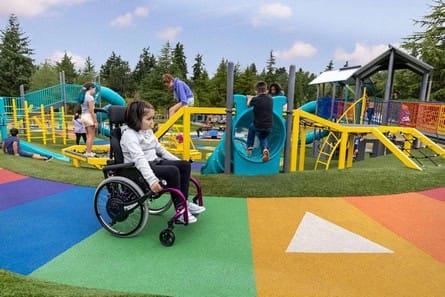
Transitions between surfaces are one of the most common real-world failures.
For example:
Concrete to bark
Rubber to grass
Path to loose fill
On paper, these transitions may appear acceptable.
In reality, they create:
Sudden resistance
Wheel trapping
Loss of balance
Trip hazards
Inclusive design requires smooth, level transitions.
Anything else creates risk.
Standards Do Not Always Reflect Reality
Standards often allow tolerances.
Designers may interpret these as acceptable limits.
But real-world use is not based on tolerances.
It is based on experience.
Research highlights that audit tools and standards alone do not capture actual usability; lived experience is required to understand real accessibility.
A design can meet the standard and still fail the user.
Safety Is the First Decision
Before a child uses equipment, a caregiver makes a decision.
Is this safe?
Research shows that caregivers prioritise safety and physical accessibility when deciding whether to use equipment.
If something looks unsafe:
They do not try it
They do not risk it
They leave
This is not hesitation.
This is protection.
Perceived Safety Is Real Safety
Design often focuses on technical safety.
But perceived safety is just as important.
If something looks:
Unstable
Difficult to access
Hard to exit
Unpredictable
It will not be used.
Inclusive design must remove doubt before use even begins.
The Problem With “Acceptable”
In design language, words like “acceptable” are common.
Acceptable step height
Acceptable tolerance
Acceptable transition
But acceptable to whom?
Designers may accept it.
Standards may allow it.
Users may not.
Real-world design must move beyond “acceptable” to “usable”.
Low Cost Often Means Compromise
Budget pressure often leads to compromises.
Lower cost can mean:
Simpler construction
Less stable equipment
Reduced usability
More difficult access
This is where problems begin.
Research shows that playgrounds can still exclude children when the design does not remove barriers to participation.
Cost savings are often made at the expense of the very features that make equipment usable.
The Truth About Underused Equipment
We often hear:
“The accessible equipment is not being used".
This is usually interpreted as a lack of demand.
In reality, it often means:
The equipment is difficult to use
It feels unsafe
It requires assistance
It creates risk
Unused equipment is not inclusive.
It is a sign of failure.
If It’s Not Used, It’s Not Accessible
Accessibility is not defined by installation.
It is defined by use.
If a child cannot use something independently
If a caregiver feels unsafe allowing use
If people walk past instead of engaging
It is not accessible.
It does not matter what it is called.
Real-World Testing Matters
Design must be tested against real behaviour.
Ask:
Can a wheelchair move through without catching?
Can a castor wheel stay on the surface?
Can a person with low vision detect changes safely?
Can an older adult move without risk of tripping?
If the answer is no, the design is not complete.
A Lived Experience Reality
From lived experience, the difference is immediate.
You do not measure a lip.
You feel it.
You do not analyse a transition.
You get stuck on it.
You do not test safety.
You decide instantly whether to take the risk.
That decision determines everything.
Design for Real Life — Not Ideal Conditions
Playgrounds are used:
When it is wet
When it is busy
When people are tired
When children move unpredictably
Design must work in these conditions.
Not just when everything is perfect.
Final Thought
Real-world design is not about meeting minimums.
It is about removing barriers completely.
A 60 mm lip is not acceptable.
An unsafe piece of equipment is not acceptable.
A surface that traps wheels is not acceptable.
Inclusive design means designing for everyone fully, safely, and confidently.
Because if something cannot be used safely in the real world, it is not inclusive.
It has just been installed.