Orientation and Navigation Design
Orientation and Navigation Design
Orientation and Navigation Design
Why Orientation Matters
Before anyone plays, they need to understand the space.
Orientation is the moment when a child, parent, or caregiver arrives and asks:
Where am I?
Where do I go?
Is this safe?
If that moment is confusing, overwhelming, or unclear, the experience starts with stress instead of confidence.
Good orientation design removes that stress.
The Entry Experience Sets Everything
The entrance to a playground is not just an access point.
It is a transition.
Design guidance shows that people need a space to orient themselves before entering active play areas, especially children and caregivers who may feel overwhelmed by stimulation.
A well-designed entry area should:
Feel calm and predictable
Provide a clear view of the playground
Allow time to understand the layout
If people are “thrown” straight into activity, confusion and anxiety increase.
Create a Clear Orientation Path
People need a simple way to understand how the playground works.
This is often achieved through a primary path or loop that connects the space.
Design guidance recommends creating an “orientation path” that allows users to move through and understand the playground layout.
This path should:
Be continuous and easy to follow
Connect all key areas
Allow users to explore without getting lost
A clear path creates confidence.
Without it, people hesitate.
Design for First-Time Visitors
Every visit is not a repeat visit.
Many users are seeing the playground for the first time.
That means the design must answer questions immediately:
Where is the equipment?
Where are the quiet spaces?
Where are the exits?
Inclusive design requires environments to be simple and intuitive to understand, regardless of experience
If someone has to stop and figure things out, the design is already working against them.
Reduce Overwhelm at the Start
Playgrounds can be busy, loud, and visually complex.
For some children, especially neurodivergent children, this can be overwhelming.
Orientation areas should:
Have lower sensory input
Avoid excessive noise or movement
Provide a calm starting point
Guidance highlights the importance of reducing sensory overload and allowing users to adjust before engaging with the activity.
This is not a luxury.
It is essential for participation.
Clear Lines of Sight
People need to see what is happening.
A caregiver needs to:
Locate their child quickly
Understand the layout at a glance
Identify potential risks
Design guidance recommends clear sightlines from entry areas into the playground so caregivers can orient themselves immediately.
If visibility is blocked, uncertainty increases.
And uncertainty reduces use.
Use Layout as Navigation
Navigation should not rely on signs alone.
The layout itself should guide movement.
This includes:
Logical placement of equipment
Clear pathways between zones
Open, readable spaces
Research shows that layout is one of the most common failure points in inclusive playground design when it becomes confusing or disconnected.
A good layout removes the need to think.
People simply move naturally.
Zones and Play “Rooms”
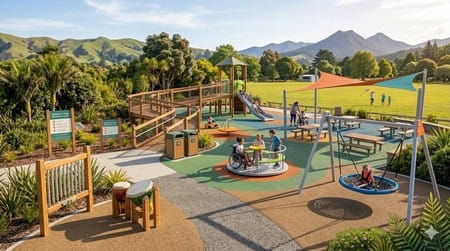
Breaking a playground into zones helps people understand it.
Design guidance suggests organising play areas into zones or “rooms” connected by pathways.
This allows users to:
Understand where they are
Choose where to go next
Move between different levels of activity
Zones also support:
Quiet areas
Active play areas
Social spaces
This creates structure without restriction.
Support Different Ways of Navigating
Not everyone navigates in the same way.
Some people rely on:
Visual cues
Tactile cues
Memory and repetition
Routine and predictability
Inclusive design recognises human diversity and ensures environments are usable for as many people as possible.
This means:
Clear paths
Consistent layout
Multiple cues
Navigation should not depend on one method.
Wayfinding Supports Orientation
Orientation and wayfinding work together.
Wayfinding tools may include:
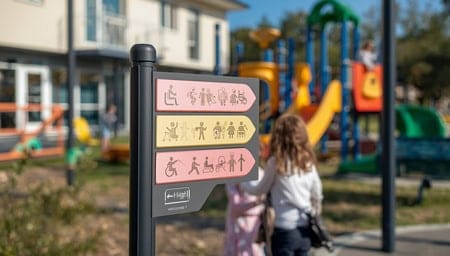
Signage
Symbols
Landmarks
Colour zones
Design guidance highlights that landmarks and clear signage help users understand where different play experiences are located.
But these should support the layout, not replace it.
If the layout is confusing, signage cannot fix it.
Avoid Dead Ends and Confusion
A good navigation system allows people to move freely.
A poor one creates:
Dead ends
Confusing routes
Blocked paths
This is especially difficult for:
Wheelchair users
Vision-impaired users
Children who rely on routine
Every path should lead somewhere useful.
Every route should make sense.
Navigation Must Support Independence
The goal of orientation design is independence.
A child should be able to:
Understand where they are
Move through the space
Return safely
A caregiver should not need to guide every movement.
Good design supports independence without removing safety.
Real-World Navigation Matters
In real life, playgrounds are:
Busy
Noisy
Unpredictable
Children move quickly. Families gather. Paths become crowded.
Navigation must still work in these conditions.
Design should not rely on ideal use.
It must work when the space is at its busiest.
A Lived Experience Reality
From lived experience, orientation happens instantly.
You arrive and either:
Understand the space
Or feel unsure
That feeling determines everything that follows.
If the space feels clear, you move forward.
If it feels confusing, you hold back.
Final Thought
Orientation and navigation are not extra features.
They are the foundation of how a playground works.
If people cannot understand the space, they cannot use it confidently.
If they cannot use it confidently, they may not use it at all.
Inclusive design starts before play begins.
It starts with knowing where you are and where you can go.