Inclusive Playground Design Guide
Inclusive Playground Design Guide for Councils
Why This Matters
Councils are not just building playgrounds.
They are shaping community spaces.
The decisions made at planning stage determine who can participate — and who cannot.
Inclusive playground design is about ensuring every child and every family can use the space safely, confidently, and equally.
Because if inclusion is not designed in from the start, it cannot be added later.
Inclusion Is More Than Accessibility
Inclusion allows participation.
Research shows that inclusive playgrounds must remove physical, social, and sensory barriers so all children can engage together.
This means:
Not just getting into the space
But being able to use it
And being able to belong
Design must support the full experience.
Start With the Whole Journey
Inclusive design begins before the playground.
It includes:
Mobility parking
Pathways
Entrances
Facilities
Guidance highlights that accessible routes, smooth surfaces, and step-free access are critical from the very beginning.
If any part of the journey fails, the playground fails.
Design for Everyone — Not the Average User
There is no “typical” user.
Inclusive playgrounds must consider:
Mobility differences
Sensory needs
Cognitive differences
Age and ability range
Inclusive design is about creating environments usable by as many people as possible — not expecting users to adapt
Design must respond to real diversity.
Provide Multiple Ways to Play
Play is not one activity.
Inclusive playgrounds must include:
Physical play
Sensory play
Social play
Quiet spaces
Guidance shows that inclusive environments should offer a range of play types to support different needs and abilities.
Not every child plays the same way.
Design must reflect that.
Ground-Level Access Is Essential
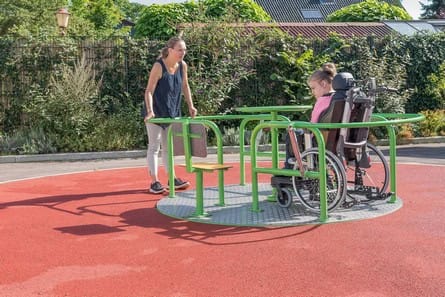
At least some of every type of play must be available at ground level.
This allows:
Wheelchair users
Children with limited mobility
Children who cannot climb
To participate fully.
Research highlights that inclusive playgrounds must include accessible play components connected by accessible routes.
If play only exists above ground, it excludes.
Surfacing Connects Everything
Surface choice is critical.
Accessible design requires:
Firm
Stable
Continuous surfaces
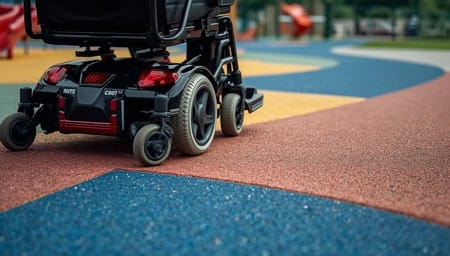
Guidance recommends unitary surfaces such as rubber to support movement and access.
Loose materials break connection.
And when the connection breaks, the inclusion breaks.
Layout Must Be Clear and Logical
A playground must be easy to understand.
This means:
Clear pathways
Connected zones
No dead ends
Children and caregivers should be able to:
See the space
Understand the layout
Move confidently
If a space is confusing, it is not inclusive.
Design for Social Inclusion
Playgrounds are social spaces.
Inclusive design must allow children to:
Play together
Interact naturally
Share experiences
Research shows inclusive playgrounds should support shared play environments where children of all abilities interact together.
Separate play is not inclusion.
Provide Choice and Flexibility
Children need options.
This includes:
High-energy play
Calm spaces
Independent play
Group play
Design guidance highlights the importance of offering both active and quiet areas to support different needs.
Choice creates inclusion.
Safety and Confidence Go Together
Safety is not just technical.
It is perceived.
Caregivers assess:
Visibility
Stability
Ease of use
If something feels unsafe, it will not be used.
Inclusive design must create confidence before participation.
Design With the Community
Inclusive playgrounds should not be designed in isolation.
They should involve:
Disabled people
Families
Local communities
Real-world example shows councils working with disability groups and communities leads to better, more usable outcomes.
Lived experience is essential.
Plan for Maintenance and Lifecycle
Inclusion must last.
Surface durability
Equipment longevity
Ongoing maintenance
If accessibility is not maintained, it is lost.
A playground that degrades becomes inaccessible over time.
Avoid Common Design Mistakes
Common failures include:
Focusing on equipment instead of experience
Using inaccessible surfaces
Designing to minimum standards
Ignoring real-world use
These mistakes are known.
They are avoidable.
Good design prevents them from the start.
Design for Real-World Use
Playgrounds are:
Busy
Unpredictable
Used in all conditions
Design must work when:
It is wet
It is crowded
It is worn
If it only works in ideal conditions, it will fail in reality.
Measure Success by Use
The true test of a playground is simple:
If children cannot:
Reach the equipment
Use it safely
Play independently
It is not inclusive.
Usage is the measure of success.
A Lived Experience Reality
From lived experience, the outcome is immediate.
A space either:
Feels usable
Or feels restrictive
Families either:
Stay
Or leave
That decision happens quickly.
Final Thought
Inclusive playground design is not about adding features.
It is about designing the entire space properly.
From parking to pathways
From surfaces to equipment
From layout to experience
Because councils are not just building playgrounds.