Beyond the Edge: Core Boards
Beyond the Edge: Bringing Core Boards into the Heart of Play
Why This Matters
Communication is part of play.
Not separate from it.
For many children, especially those who are non-verbal or use AAC (Augmentative and Alternative Communication), the ability to communicate determines whether they can participate at all.
If communication is placed at the edge of a playground, participation is also pushed to the edge.
Inclusive design must bring communication into the centre of play.
What Core Boards Are
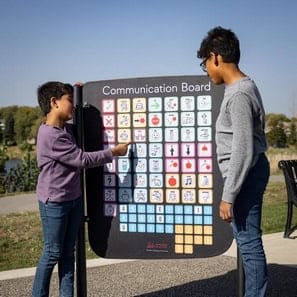
Core boards are communication tools.
They use:
Symbols
Words
Images
They allow children to:
Express needs
Make choices
Interact with others
Research shows that playground communication boards support independence, participation, and inclusion for children who use AAC.
They are not optional extras.
They are access.
The Problem With Current Placement
In many playgrounds, core boards are:
Placed on the outskirts
Mounted away from the equipment
Separated from activity
This creates a clear problem.
Children must:
Leave play
Go to the board
Communicate
Then return
In real life, this does not happen.
Play moves quickly.
Children do not leave the moment to communicate.
So communication is lost.
Access to Communication Must Be Immediate
Research shows that simply providing communication tools is not enough.
Children are more likely to use them when they are embedded naturally into their environment and supported in context.
If communication is not available when needed, it is not accessible.
Timing matters.
Placement matters.
Play Happens in the Moment
Play is fast.
It is:
Spontaneous
Unpredictable
Social
Children do not pause to find a tool.
They:
React
Respond
Join in
If communication is not part of that moment, the child is excluded from it.
Bring Communication Into the Play Space
Core boards should not sit outside the playground.
They should be:
Integrated into equipment
Placed within play zones
Available at key interaction points
This allows children to:
Communicate while playing
Stay engaged
Interact naturally
Communication becomes part of play, not separate from it.
Design for Interaction, Not Isolation
When boards are placed on the edge, they create isolation.
When integrated into play, they create connection.
Communication boards can:
Help children ask to join
Express preferences
Share ideas
They also support other children to engage and respond.
Research shows these tools can promote social interaction and inclusion across all users, not just those with disabilities.
This is how inclusion grows.
Visibility and Accessibility Matter
Core boards must be:
Easy to find
At the right height
Reachable from different positions
If a child cannot:
Reach the board
See the board
Understand the board
It will not be used.
Placement is everything.
Consistency Supports Use
Children learn through repetition.
Communication boards should:
Use consistent layouts
Appear in multiple locations
Be predictable in design
Guidance highlights that consistent visual communication systems improve usability and understanding across environments.
If every board is different, learning is lost.
Communication Is for Everyone
Core boards are not just for non-verbal children.
They also support:
Children with speech delays
Neurodivergent children
Children learning language
Children who communicate differently
They can even help children:
Learn new words
Understand others
Build empathy
Communication tools benefit everyone.
Rethinking Playground Design
The traditional model separates:
Play
Communication
Support
Inclusive design brings them together.
Instead of:
Play over here
Communication over there
We need:
Play and communication together
This is the shift.
Innovation: Communication Built Into Equipment
Future-focused design should consider:
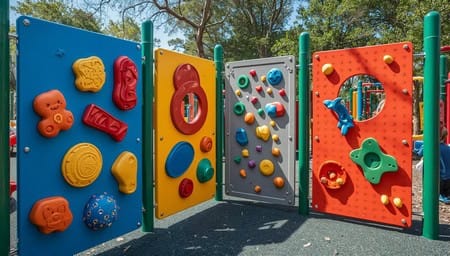
Boards built into climbing structures
Panels integrated into play equipment
Communication points within social spaces
One idea is adding alert or signal devices near communication boards, allowing a child to attract attention when they want to interact.
This solves a real problem:
Being seen
Being heard (without speech)
Being included
Design must respond to real behaviour.
The Cost of Getting It Wrong
When communication is not integrated:
Children cannot express themselves
Social interaction is reduced
Frustration increases
Participation drops
The playground may be physically accessible.
But it is not socially inclusive.
If Communication Is Not Used, It Is Not Accessible
We often see communication boards installed but underused.
The assumption is:
“They are not needed”.
The reality is:
They are not placed correctly
They are not integrated
They are not part of play
Unused communication tools are not inclusive.
They are misplaced.
A Lived Experience Reality
From lived experience, the difference is clear.
When communication is:
At the edge, it is ignored
In the play space, it is used
Children do not go looking for communication.
They use what is in front of them.
Design determines that outcome.
Design for Inclusion, Not Appearance
Adding a core board is not enough.
It must be:
In the right place
Part of the experience
Easy to use in the moment
Otherwise, it becomes a feature that looks inclusive but does not function.
Final Thought
Communication is not separate from play.
It is part of it.
Core boards must move from the edge to the centre.
Because inclusion is not about providing tools.
It is about making sure those tools are used.
And that only happens when they are part of the experience.