Accessible Toilets
Accessible Toilets Matter
Why Accessible Toilets Matter in Inclusive Playgrounds
Accessible toilets are not an optional extra. They are essential.
A playground can have inclusive equipment, accessible pathways, and thoughtful design, but without accessible toilets, many families simply cannot stay.
For disabled children, adults, carers, and families, access to a suitable toilet determines how long they can stay at a playground, whether they feel comfortable visiting, and whether they return.
Inclusion does not stop at play. It must include dignity, privacy, and basic human needs.
Accessibility Is About Independence and Dignity
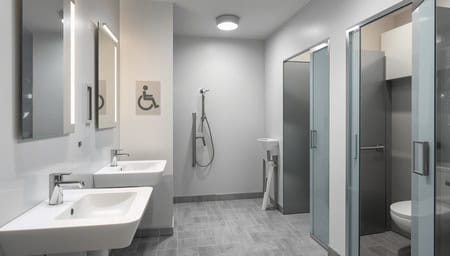
An accessible toilet is not just a larger cubicle.
It is a space designed so that a person can use it safely and comfortably, with as much independence as possible.
This includes enough room to move, transfer from a wheelchair, reach fixtures, and use the space without unnecessary assistance.
Features such as grab rails, the correct toilet height, and clear floor space are essential for safe transfers and use.
Without these features, a toilet may exist but be unusable.
Size and Space Are Critical
Accessible toilets must provide enough space for real-world use.
In New Zealand, a typical accessible toilet layout measures around 1600 mm by 1900 mm, allowing a wheelchair user to manoeuvre.
A turning circle of approximately 1500 mm is commonly required to allow a wheelchair user to turn safely.
This space is not excessive, it is necessary.
Wheelchair users need room to position themselves beside the toilet, transfer safely, and move without hitting walls, basins, or doors.
If space is compromised, usability is lost.
Location Matters Just as Much as Design
An accessible toilet must be easy to find and easy to reach.
It should be located on an accessible route, close to the playground, and connected by a wide, level, and usable path for mobility devices.
If a family has to travel long distances, cross difficult terrain, or navigate barriers just to reach a toilet, the playground is not truly accessible.
Accessible toilets should feel like part of the playground, not an afterthought placed far away.
Doors, Layout, and Approach
Small design decisions make a big difference.
Doors should be wide enough for wheelchairs and, ideally, open outward or slide open, so they do not reduce interior space.
Inside the toilet, fixtures must be positioned so they do not block movement or access.
There must be a clear transfer space beside the toilet, and the basin should not interfere with that space.
Even small layout mistakes, a poorly placed bin, a hand dryer in the wrong position, or a door swinging into the turning space, can make the toilet unusable.
Transfer Space and Safety
For many wheelchair users, using a toilet involves transferring from their chair onto the toilet seat.
This requires clear space beside the toilet, stable grab rails, and correct positioning.
Guidance in New Zealand indicates a minimum transfer space of around 850 mm beside the toilet to allow safe movement and positioning.
Without this space, the user may not be able to transfer at all.
Safety is not theoretical; it is physical.
If a transfer cannot be done safely, the toilet cannot be used.
Fixtures Must Be Reachable
Everything inside an accessible toilet must be within reach from a seated position.
This includes:
Flush controls
Toilet paper
Hand basin
Soap dispensers
Hand dryers
Locks and latches
Controls should be easy to operate and positioned at accessible heights, generally no higher than around 1200 mm above the floor.
If something cannot be reached, it effectively does not exist for the user.
Unisex and Family-Friendly Design
Accessible toilets should be unisex wherever possible.
This allows carers of any gender to assist children or adults without barriers.
Where only one toilet is provided, it should be accessible and usable by everyone.
Family-friendly design also means allowing space for more than one person.
Many disabled children require assistance. Many adults require support. A toilet that only fits one person does not meet real-world needs.
Beyond Minimum Compliance
Meeting minimum standards is not the same as achieving inclusion.
True inclusive design goes further.
It considers:
Space for carers
Space for larger mobility devices
Space for power chairs
Changing facilities for older children
Emergency call systems
Privacy and comfort
Some users require adult-sized changing benches or hoists. Without these, families may avoid the playground entirely.
Minimum compliance may meet regulations, but it often fails real people.
Maintenance Is Part of Accessibility
An accessible toilet that is locked, broken, dirty, or used as a storage space is not accessible.
Maintenance is critical.
Councils and operators must ensure:
Toilets are open and available
Fixtures are working
Emergency systems function
Supplies are stocked
Spaces are clean and safe
When accessible toilets are poorly maintained, the impact is immediate. People are forced to leave.
Common Mistakes in Playground Toilets
Accessible toilets are often included in design plans but fail in execution.
Common issues include:
Toilets are located too far from the playground
Paths leading to the toilet that are not accessible
Doors that are too heavy or open inward
Bins or fixtures blocking the transfer space
Insufficient turning room
Poor signage or unclear location
Locked facilities requiring keys
No space for carers
These are not minor problems. They are barriers.
A Lived Experience View
From lived experience, accessible toilets are among the biggest factors in whether a playground is usable.
Families plan outings around toilet access.
A great playground without a usable toilet becomes a short visit or no visit at all.
A well-designed accessible toilet extends time, increases comfort, and allows children to simply enjoy being there.
This is not about convenience. It is about inclusion.
Final Thought
Accessible toilets are not just facilities.
They are a statement.
They show whether a playground was designed for everyone or only for some.
If a child can play but cannot use the toilet, the design has already failed.
True inclusion means thinking beyond the play equipment and designing for the full experience.
Because everyone deserves to stay.