Accessible Seating & Rest Areas
Accessible Seating & Rest Areas
Why Seating Matters in Inclusive Playgrounds
Seating is not an optional extra. It is a core part of inclusive design.
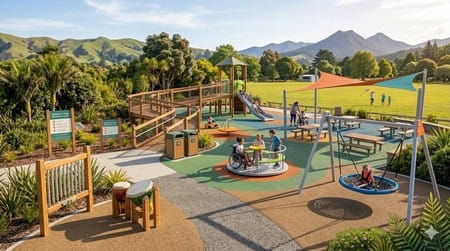
Playgrounds are active environments, but they also need spaces for rest, supervision, social connection, and recovery. For many disabled children and adults, the ability to stop, sit, and recharge is essential to staying and participating.
Without accessible seating, people are forced to leave early, sit on unsuitable surfaces, or avoid the space entirely.
Inclusive playgrounds must support both movement and rest.
Rest Is Part of Participation
Not everyone experiences a playground in the same way.
Some children need frequent breaks. Some adults cannot stand for long periods. Some people experience fatigue, pain, or sensory overload.
Providing well-placed seating allows people to:
Pause and recover
Stay longer
Feel safe and supported
Remain close to the play activity
Guidance highlights that seating is critical wherever people need to rest, wait, or observe activities.
Rest is not separate from play. It is part of it.
Seating Must Be Located Where It Is Needed
Good seating is not hidden away.
It should be:
Along accessible pathways
Near play equipment
Close to entrances and exits
Near toilets, water, and shade
Positioned to allow clear views of play areas
People need to be able to sit and still be part of the experience.
Parents and caregivers need to supervise. Children need to feel included even when resting.
Seating placed too far away creates separation instead of inclusion.
Keep Seating Off the Main Path
Seating must not block movement.
New Zealand guidance requires that street furniture, including seating, be placed clear of accessible routes so it does not obstruct travel.
Seating should sit beside pathways, not within them.
There should always be a clear, unobstructed route for:
Wheelchairs
Powerchairs
Mobility scooters
Prams
Walking frames
Good design balances access and rest without conflict.
Provide Space for Wheelchairs Beside Seating
Accessible seating is not just about the seat itself.
Wheelchair users must be able to sit alongside others, not separated from them.
This means:
Providing clear space beside benches
Allowing room for a wheelchair next to standard seating
Ensuring level, firm surfaces around seating
Guidance emphasises that wheelchair users should be able to sit next to companions rather than in isolated positions.
Inclusion means sitting together.
Seat Design Matters
Not all seating is usable.
Accessible seating should include:
Back support
Armrests to assist sitting and standing
Stable, firm construction
Adequate seat width and depth
Standards suggest typical seat heights of around 450 mm, with variations to suit different users.
Armrests are particularly important. They provide leverage for people who need assistance getting up.
A flat bench without support may look simple, but it excludes many users.
Provide a Range of Seating Options
No single seating type works for everyone.
Inclusive playgrounds should include a mix of:
Standard benches with backrests
Seats with armrests
Low seating for children
Higher seating for older adults
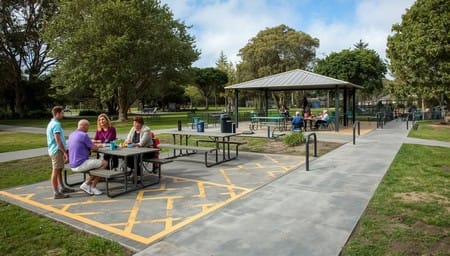
Picnic tables with wheelchair access
Quiet seating areas away from activity
Providing variety allows people to choose what works best for them.
One type of seat is not inclusive.
Accessible Picnic Tables and Social Spaces
Seating is also about social connection.
Picnic tables and shared seating areas allow families and groups to gather, eat, and interact.
Accessible picnic tables must:
Allow wheelchair users to roll underneath
Be placed on firm, stable surfaces
Provide clear space around them
Poorly designed picnic tables often exclude wheelchair users, especially when placed on grass or loose surfaces.
A table everyone can use creates a shared experience.
Shade and Comfort Are Essential
Seating without comfort is not usable.
Rest areas should consider:
Shade from sun exposure
Shelter from wind and rain
Comfortable materials that do not overheat
Protection from glare
A seat in full sun may technically exist, but it may not be usable for long periods.
Comfort supports longer stays and better experiences.
Think About Sensory Needs
Some users need quiet, low-stimulation spaces.
Inclusive playgrounds should include seating areas that are:
Away from noise and high activity
Calm and predictable
Visually simple
Comfortable and safe
These spaces allow children and adults to regulate, recover, and return to play when ready.
Inclusion includes sensory needs, not just physical access.
Spacing and Frequency of Seating
Seating should be provided regularly throughout the playground.
People should not have to travel long distances to find a place to sit.
Regular seating intervals along pathways and within play areas ensure:
Continuous accessibility
Reduced fatigue
Greater independence
A single seating area is not enough.
Inclusive design spreads opportunity throughout the space.
Maintenance Matters
A broken or damaged seat is a barrier.
Seating must be:
Well maintained
Clean
Safe to use
Structurally sound
Loose boards, sharp edges, or unstable seating create risk and reduce usability.
Maintenance is part of accessibility.
Common Mistakes
Accessible seating often fails due to simple oversights.
Placed too far from play areas
Blocking accessible paths
No space for wheelchairs beside the seating
No armrests or back support
Too low or too high for users
Located on uneven or soft ground
No shade or shelter
These issues make seating an afterthought rather than a usable feature.
A Lived Experience View
From lived experience, seating is not just about rest.
It is about inclusion, comfort, and being part of the moment.
A parent needs to sit and still supervise their child. A child may need a break but still wants to feel included. A wheelchair user wants to sit with friends, not apart from them.
When seating is designed well, people stay longer and feel welcome.
When it is not, people leave.
Final Thought
Accessible seating is one of the simplest features to get right — and one of the easiest to get wrong.
It is not just about providing a place to sit.
It is about creating spaces where people can pause, connect, and remain part of the experience.
Inclusive playgrounds support both movement and rest.
Because everyone deserves a place to sit and a place to belong.