Powerchair Turning Circles
Powerchair Turning Circles
Why Turning Space Matters
Movement is not just about getting through a space.
It is about being able to turn, reposition, and move freely without getting stuck.
For many users, especially powerchair users, turning space is one of the most critical parts of the design.
If a person cannot turn, they cannot use the space.
Minimum Standards vs Real Use
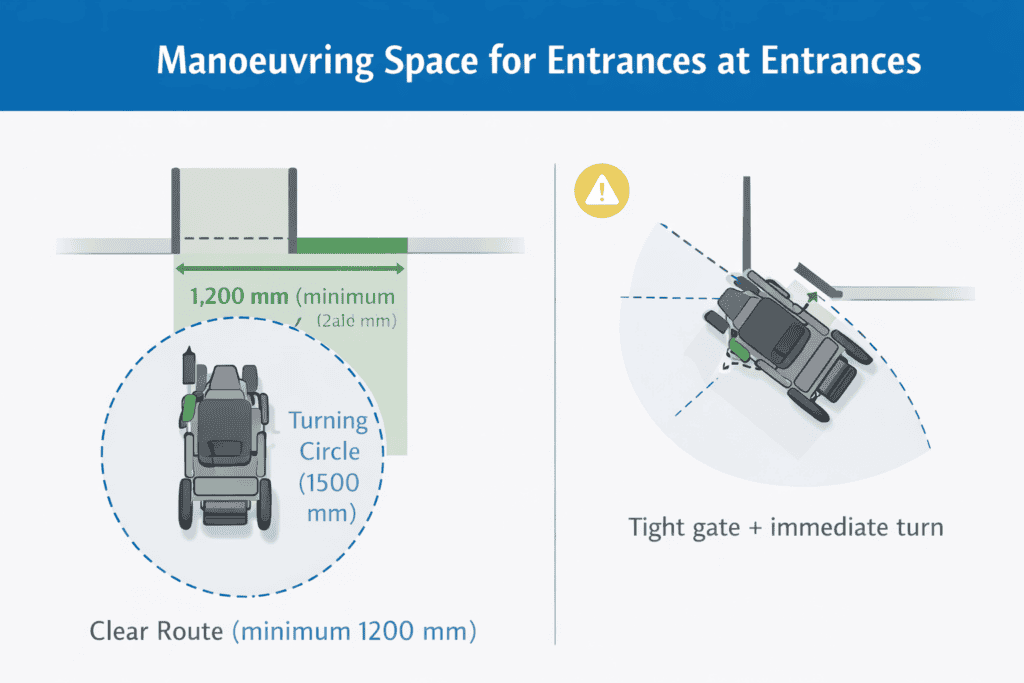
New Zealand accessibility guidance commonly references a 1500 mm turning circle as the minimum space required for a wheelchair to turn.
This is considered sufficient for many manual wheelchairs.
But real-world use is different.
Powerchairs are:
Longer
Wider
Heavier
Less agile in tight spaces
The same standards also acknowledge that larger turning spaces may be needed, depending on the wheelchair type.
Minimum does not mean suitable.
Powerchairs Change the Design Brief
A powered wheelchair with a user can easily exceed:
200 kg in weight
Larger overall footprint
Wider turning radius
These chairs cannot be:
Lifted
Pivoted manually
Forced through tight spaces
They require space to move naturally.
Design must reflect this reality.
1500 mm Is Not Always Enough
While 1500 mm is often used as a baseline, guidance also recommends larger turning circles up to around 1800–1985mm to accommodate a wider range of users.
In real playground environments:
1500 mm may allow a turn
But not a comfortable one
Not under pressure
Not with obstacles nearby
This creates hesitation and difficulty.
Real-World Turning Is Not Perfect
On paper, turning happens in a clear, open circle.
In real life:
Paths are busy
Surfaces create resistance
Edges and lips interfere
Other users are moving
Turning space must account for:
Imperfect conditions
Unexpected obstacles
Real movement patterns
Design must go beyond ideal conditions.
Turning Requires Clear Space Not Just Diameter
A turning circle is not just a measurement.
It must be:
Clear of obstacles
Level and stable
Free from edges or lips
Even small obstructions can:
Stop movement
Trap wheels
Force unsafe manoeuvres
A turning space that is technically correct but physically blocked is not usable.
Castor Wheels Make Turning Harder
Many powerchairs and wheelchairs use front and rear castors.
These small wheels are highly sensitive to:
Edges
Surface changes
Gaps
During turning, castors often take the most stress.
If they catch or drop:
The chair can stop suddenly
The user can become stuck
Movement becomes unsafe
Turning design must protect castors at all times.
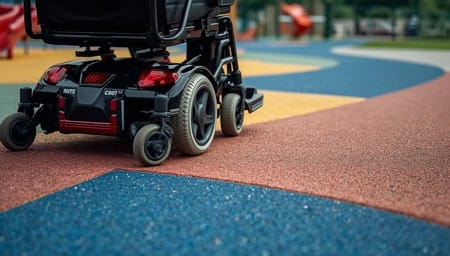
Surface Matters During Turning
Turning increases resistance.
This means surfaces must be:
Firm
Stable
Consistent
Loose surfaces like bark or sand:
Increase effort
Cause drag
Make turning difficult or impossible
If a user cannot turn easily, they will avoid the space.
Space Around Equipment Is Critical
Turning does not just happen on pathways.
It happens:
At equipment entry points
At seating areas
At transitions
If there is no space to turn:
A user cannot position themselves
Cannot access the equipment
Cannot exit safely
Every key point must allow for turning.
Design for Approach, Use, and Exit
Turning is required at every stage:
Approach aligning with the equipment
Use positioning safely
Exit, leaving without reversing long distances
If any of these fail, the experience breaks down.
Design must support the full sequence.
Tight Spaces Create Risk
When turning space is too small:
Users reverse repeatedly
Make multiple corrections
Risk of hitting obstacles
Lose confidence
This is not just inconvenient.
It is unsafe.
Independence Depends on Turning Space
If a user cannot turn independently:
They need assistance
They lose control
They lose confidence
Inclusive design aims to remove reliance on others.
Turning space is essential to that independence.
Real-World Behaviour
In real playgrounds:
People do not measure turning circles
They do not attempt complex manoeuvres
They decide quickly:
Can I move easily?
Can I turn safely?
If the answer is no, they leave.
A Lived Experience Reality
From lived experience, the difference is immediate.
A space either:
Feels open and usable
Or feels tight and restrictive
You either turn smoothly
Or you struggle
That moment defines whether the space works.
Design Beyond Minimums
Minimum standards provide a baseline.
But inclusive design should aim for:
More space
Better flow
Easier movement
Because real users are not average.
And real environments are not perfect.
Final Thought
Turning space is not a technical detail.
It is a fundamental requirement.
A 1500 mm circle may meet the standard.
But real inclusion often requires more.
Because if a person cannot turn safely, they cannot use the space.
And if they cannot use the space, it is not inclusive.