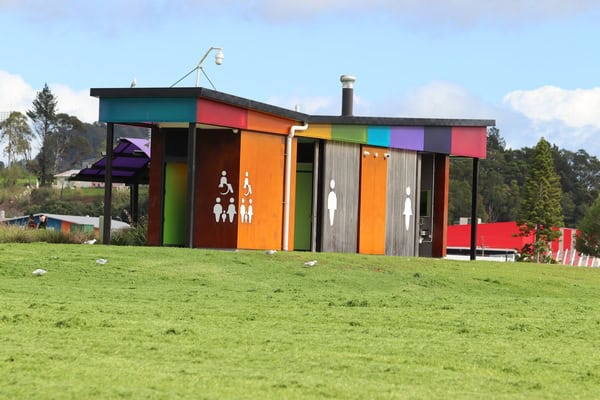
Accessible Toilet Design Guide
Accessible Toilet Design Guide
Accessible Toilet Design Guide
Why This Guide Matters
Accessible toilet design is not just about meeting building standards. It is about whether a person can use the space safely, independently, and with dignity.
In playgrounds, accessible toilets are one of the most critical parts of the overall experience. If the toilet does not work, the visit ends.
Good design removes stress, reduces risk, and allows families to stay longer, relax, and fully participate.
Start With Space — Everything Depends on It
Accessible toilet design begins with space.
In New Zealand, a typical accessible toilet layout is around 1600 mm by 1900 mm, with a 1500 mm turning circle for wheelchair manoeuvring.
This space is not generous, it is essential.
A wheelchair user needs room to:
Position beside the toilet
Turn safely
Transfer without hitting walls or fixtures
Adjust position if something goes wrong
If space is compromised, the entire design fails.
Design for Transfer, Not Just Access
Getting into a toilet is not the same as being able to use it.
Many wheelchair users need to transfer from their chair onto the toilet seat. This requires a clear space beside the toilet, typically around 850 mm, to allow safe movement.
Grab rails must be correctly positioned and strong enough to support the user's body weight.
The toilet height should align with the wheelchair seat height, typically around 460–480 mm, to make transfers safer and easier.
Without proper transfer design, the toilet may be technically compliant but unusable.
Doors Must Not Fight the User
Doors are one of the most common failure points.
An accessible toilet door should:
Be wide enough for a wheelchair (minimum clear opening around 760 mm)
Open outward or slide to preserve internal space
Be easy to operate with limited strength or dexterity
A door that swings inward reduces usable space and can trap the user.
If a person struggles to enter or exit, the design has already failed.
Layout Must Keep Movement Clear
Everything inside the toilet must be positioned with intention.
The toilet pan, basin, grab rails, and accessories must not interfere with movement or transfer space.
For example:
The basin must not block access to the toilet
The turning circle must remain clear
Fixtures must not intrude into transfer zones
Even small mistakes, like placing a bin in the wrong position, can make the space unusable.
Accessible design is about keeping movement zones clear at all times.
Reachability Is Non-Negotiable
Every feature must be reachable from a seated position.
This includes:
Flush controls
Toilet paper
Soap dispensers
Hand dryers
Locks and privacy latches
Controls are typically positioned no higher than 1200 mm to ensure usability.
If a person cannot reach something, it effectively does not exist.
Flat, Stable Floors Are Critical
The floor inside an accessible toilet must be level and stable.
Slopes, even small ones, create serious problems during transfers. A wheelchair user needs a flat surface to safely transfer from a chair to the toilet.
Slip resistance is also important, but it must not come at the cost of increased rolling resistance.
The goal is stability, not just compliance.
Design for Carers and Real Use
Many users do not use toilets independently.
Children may need assistance. Adults may require support. Some users need space for hoists or changing equipment.
Where possible, the design should allow:
Space for a caregiver
Room for larger mobility devices
Flexible layout for different needs
Guidance also encourages unisex accessible toilets so that carers of any gender can assist without barriers.
If only one person can fit inside, the design does not reflect real-world use.
Consider Changing Places — Beyond Standard Toilets
Standard accessible toilets do not meet all needs.
Some people require:
Adult-sized changing benches
Hoists
More space for complex care
“Changing Places” facilities are designed to meet these needs and provide consistent, higher-level accessibility across locations.
In destination playgrounds, these should be seriously considered.
Location and Access Are Part of the Design
An accessible toilet must be easy to reach.
It should be:
Close to the playground
Connected by an accessible pathway
Easy to find with clear signage
Safe to access at all times
Building guidance requires accessible toilets to be located on accessible routes and in convenient locations.
A well-designed toilet in the wrong location is still a barrier.
Maintenance Is Design
An accessible toilet is only as good as its condition.
If it is locked, broken, dirty, or used as storage, it is not accessible.
Ongoing maintenance must ensure:
Doors and locks function
Fixtures work correctly
Emergency systems operate
Supplies are stocked
Spaces remain clean and safe
Accessibility is not achieved once. It must be maintained.
Common Design Failures
Accessible toilets often fail in predictable ways.
Too small for real use
Poor door design
Blocked transfer space
Fixtures out of reach
Incorrect grab rail placement
Located too far from the playground
No space for carers
No consideration for powerchairs
These are not technical errors; they are design failures.
A Lived Experience View
From lived experience, accessible toilets are one of the most important parts of any inclusive space.
Families plan around them. Children rely on them. Carers depend on them.
A playground without a usable toilet is not inclusive, no matter how good the equipment is.
When toilets are designed well, people stay longer, feel safer, and participate fully.
Final Thought
Accessible toilet design is not about ticking a box.
It is about whether someone can use the space without fear, without assistance, and without compromise.
If a person cannot use the toilet, they cannot fully use the playground.
Design for dignity. Design for real life.