Designing for Blind Users
Designing for Blind Users
Why This Matters
Not all children experience a playground through sight.
For blind children, understanding, movement, and interaction rely on touch, sound, memory, and spatial awareness.
If a playground depends on vision to navigate or participate, it creates barriers.
Inclusive design must ensure that blind users can move, understand, and play independently without relying on sight.
Understanding Without Vision
Blind children do not “see” the playground.
They understand it through:
Touch
Sound
Movement
Spatial memory
Research shows that tactile and sensory features are essential for helping children who are blind orient themselves and understand where they are in a space.
If a space cannot be understood without sight, it cannot be used independently.
Orientation Comes First
Before play begins, a child needs to understand the layout.
This includes:
Where they are
Where equipment is located
Where hazards exist
Studies highlight that features like tactile maps, landmarks, and sensory cues are critical for navigation and orientation.
Without orientation, confidence is lost.
Touch Is the Primary Guide
For blind users, touch replaces vision.
This includes:
Hands exploring surfaces
Feet detecting ground changes
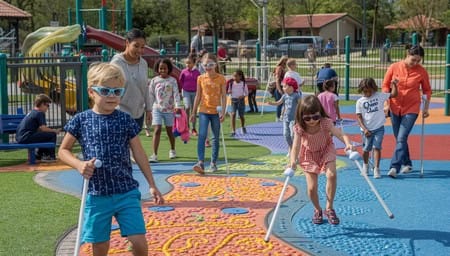
Mobility canes read the environment
Tactile elements such as textured surfaces and raised features help users understand space and identify key areas.
If there is nothing to feel, there is nothing to guide.
Tactile Ground Cues Improve Safety
The ground itself must communicate.
Tactile surfaces can:
Indicate pathways
Mark boundaries
Warn of hazards
Systems like tactile paving use textured patterns to alert users to changes and dangers underfoot.
Without these cues, hazards become invisible.
Consistent Layout Builds Confidence
Blind users rely on memory and repetition.
This means the environment must be:
Predictable
Consistent
Logical
If pathways change suddenly or layouts feel random, navigation becomes difficult.
Consistency allows users to learn and move independently.
Clear Boundaries Are Essential
Blind users need to understand where the playground begins and ends.
This can be achieved through:
Fencing
Edges
Changes in surface texture
Design guidance recommends using physical and tactile boundaries to signal safe and unsafe areas.
Without boundaries, the space becomes uncertain.
Surface Choice Matters
Ground surfaces directly affect usability.
Loose materials like bark or sand:
Shift underfoot
Provide no consistent feedback
Trap mobility devices
Firm, stable surfaces allow:
Reliable movement
Clear tactile feedback
Safer navigation
If the ground cannot be read, the space cannot be trusted.
Multi-Sensory Design Supports Understanding
Blind users rely on multiple senses.
Playgrounds should include:
Sound cues (bells, chimes, movement)
Textured elements
Scented planting
Research shows that multi-sensory features help children who are blind explore, engage, and understand their environment.
This creates richer, more inclusive play.
Design for Safe Exploration
Exploration is part of play.
But it must be safe.
This means:
Marking edges and level changes
Avoiding unexpected obstacles
Providing clear transitions
Guidance recommends highlighting hazards through tactile or high-contrast cues so users can detect them early.
Unexpected hazards create risk.
Avoid Hidden Obstacles
Blind users cannot avoid what they cannot detect.
Design should avoid:
Protruding elements
Low obstacles
Unmarked changes in level
All hazards must be:
Detectable
Predictable
Consistent
If something cannot be detected, it becomes dangerous.
Support Independent Movement
The goal is independence.
A child should be able to:
Move through the playground
Find equipment
Return safely
Without constant assistance.
Design must support this through:
Clear pathways
Tactile guidance
Logical layout
Independence is the measure of success.
Social Play Must Be Accessible
Blind children should be able to:
Join in play
Interact with others
Share experiences
Design should support:
Group play through touch and movement
Equipment that encourages shared interaction
Spaces that allow connection without relying on sight
If play depends on visual cues, some children are excluded.
Real-World Behaviour
In real playgrounds:
Children explore by moving
They learn through repetition
They build confidence over time
Design must support this natural behaviour.
If the environment is unclear or unsafe, exploration stops.
A Lived Experience Reality
From lived experience, the difference is immediate.
A space either:
Feels understandable
Or feels uncertain
A child either:
Moves forward
Or stops
That decision happens instantly.
Design determines the outcome.
Final Thought
Designing for blind users is not about adding features.
It is about making the environment readable without sight.
When playgrounds provide tactile guidance, clear layout, and safe exploration, children can move confidently and independently.
When they rely on vision, they exclude.
Because inclusion is not about what can be seen.
It is about what can be understood.