Vibration and Movement Play
Vibration and Movement Play
Why This Matters
Play is not just what children see or hear.
It is what they feel.
For many children, especially those with sensory needs, movement and vibration are essential ways of understanding the world.
If a playground only offers visual or sound-based experiences, it excludes.
Inclusive design must include movement and vibration as core parts of play.
Movement Is a Form of Sensory Input
Children learn through movement.
This includes:
Swinging
Spinning
Rocking
Balancing
These activities stimulate the body’s vestibular system, the system responsible for balance and spatial awareness.
Research shows that movement-based play supports coordination, balance, and overall development.
Movement is not just fun.
It is how many children regulate and understand their bodies.
Vibration Creates a Different Way to Feel Play
Not all children respond to sound.
But vibration can be felt.
Vibration-based play allows children to:
Feel rhythm
Experience feedback through touch
Engage without relying on hearing
This is especially important for:
Deaf children
Hard of hearing children
Children with sensory processing differences
It provides another pathway into play.
Movement Supports Regulation
Some children seek movement.
Others need it to feel calm.
Repetitive motion such as:
Swinging
Rocking
Spinning
Can help children:
Regulate emotions
Reduce anxiety
Feel more in control
Research highlights that sensory play, including movement, supports emotional regulation and reduces stress.
This is not optional.
It is essential for participation.
Different Children Need Different Input
Children experience movement differently.
Some seek:
Fast spinning
High movement
Strong input
Others prefer:
Gentle rocking
Slow movement
Controlled motion
Inclusive design must provide a range of options.
There is no single “right” level of movement.
Movement Creates Social Play
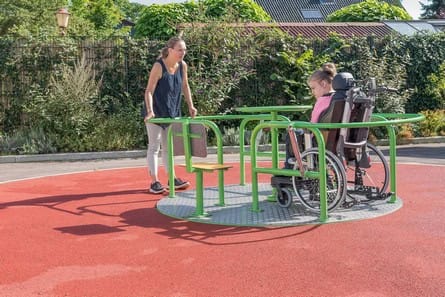
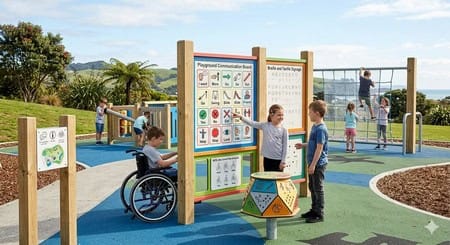
Movement-based equipment often brings children together.
Examples include:
Seesaws
Group swings
Spinners
These allow children to:
Share rhythm
Respond to each other
Play together without words
Research shows that inclusive play environments encourage social interaction and shared experiences.
Movement becomes a way to connect.
Vibration as Communication
Vibration can also act as communication.
It can:
Signal interaction
Provide feedback
Create a shared experience
For children who do not rely on sound, vibration becomes a way to:
Feel what others are doing
Respond to movement
Join in
Play becomes physical communication.
Design for Safe Movement
Movement introduces risk if not designed properly.
Equipment must be:
Stable
Predictable
Supportive
Children need to feel:
Secure while moving
Able to stop safely
Confident using the equipment
If movement feels unsafe, it will not be used.
Space Around Movement Equipment Matters
Movement requires space.
This includes:
Clear zones around equipment
Safe distances between features
Room for entry and exit
If space is restricted:
Movement becomes dangerous
Interaction becomes limited
Design must allow movement to happen safely.
Surface Matters for Movement Play
Movement equipment depends on surface quality.
Surfaces must:
Absorb impact
Remain stable
Support mobility devices
Loose or uneven surfaces:
Reduce safety
Limit access
Create risk
If a child cannot reach the equipment safely, they cannot use it.
Avoid Over-Controlled Design
Movement play should feel natural.
Overly restrictive design:
Limits freedom
Reduces enjoyment
Prevents self-directed play
Inclusive design allows:
Choice
Exploration
Different ways of engaging
Children should be able to control how they move.
Support Both Active and Calm Movement
Not all movement is high energy.
Playgrounds should include:
Active movement zones
Calming movement options
For example:
Fast spinners for stimulation
Gentle swings for calming
This balance allows children to choose what they need.
Real-World Behaviour
In real playgrounds:
Children move constantly
They repeat actions
They seek out what feels good
Movement is not structured.
It is instinctive.
Design must support this natural behaviour.
A Lived Experience Reality
From lived experience, the difference is immediate.
A space either:
Invites movement
Or restricts it
A child either:
Engages repeatedly
Or walks away
That decision is based on how the movement feels.
Movement Is Not an Extra Feature
Movement and vibration are often treated as optional.
They are not.
They are core to:
Development
Regulation
Social interaction
Without them, many children cannot engage fully.
Final Thought
Vibration and movement are fundamental parts of inclusive play.
They allow children to:
Feel the environment
Regulate their bodies
Connect with others
When playgrounds include movement and vibration, they open up new ways to play.
When they do not, they limit participation.
Because inclusion is not just about what children can see or hear.
It is about what they can feel.