Councils Should Ask
Questions Councils Should Ask When Planning Inclusive Playgrounds
Questions Councils Should Ask When Planning Inclusive Playgrounds
Inclusive playgrounds are most successful when accessibility is considered from the very beginning of the design process. Asking the right questions early helps ensure that playgrounds work for the widest range of people in the community.
The following questions can help guide better decisions when planning accessible play spaces.
Can People Reach the Playground Independently?
Accessibility starts before someone enters the play space.
Councils should consider:
Is there an accessible path from parking areas and public walkways?
Are entrances wide enough for wheelchairs and mobility scooters?
Are there barriers such as steps, lips, or steep gradients?
A playground cannot be considered accessible if people cannot reach it independently.
Can People Move Through the Playground?
Once inside the playground, users should be able to move freely between play elements.
Questions to consider include:
Are surfaces firm and stable enough for wheelchairs and walking aids?
Are paths wide enough for mobility devices to turn and pass each other?
Are there level transitions between surfaces?
Accessible circulation allows people to explore the entire play space, not just a small section of it.
Can Equipment Be Used Without Lifting?
Some equipment described as accessible still requires carers to lift users into place.
Councils should ask:
Can wheelchair users access equipment directly?
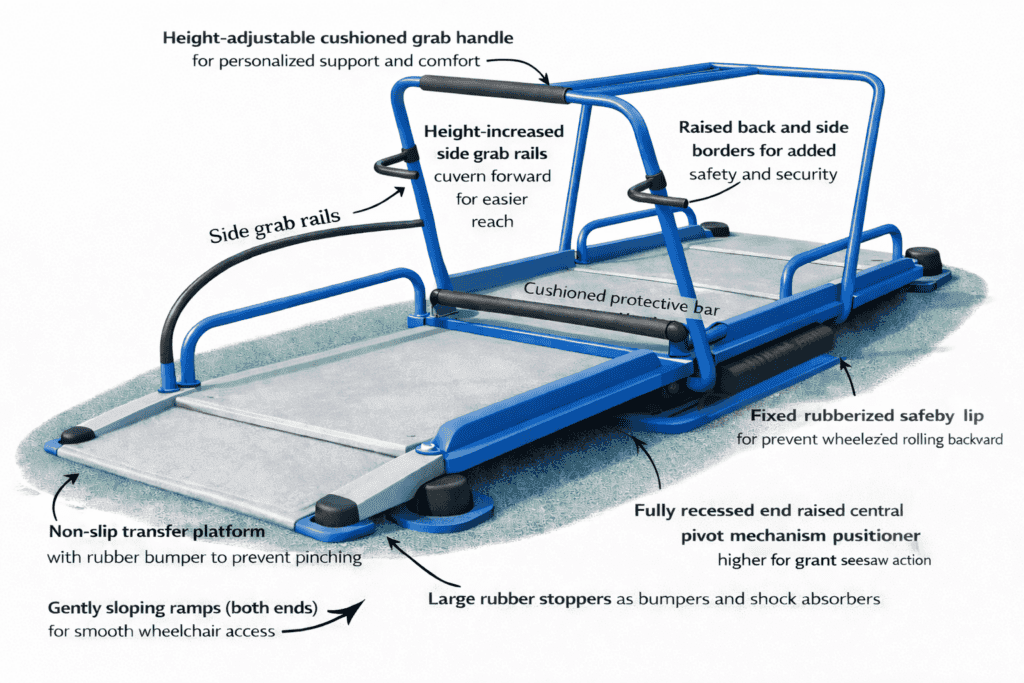
Are there transfer platforms or ground-level play options?
Does the design reduce or eliminate manual lifting?
Equipment that relies on lifting limits independence and may create manual handling risks for carers.
Does the Playground Support a Range of Abilities?
Inclusive playgrounds should offer a variety of play experiences so that people with different abilities can participate.
This may include:
movement-based play
sensory experiences
social and cooperative play
quiet spaces for regulation and rest
Providing a range of play opportunities ensures that more people can participate meaningfully.
Is the Playground Designed for All Ages?
Disability is not limited to childhood. Many users of accessible playgrounds include:
teenagers with disabilities
disabled adults
stroke survivors
grandparents with mobility challenges
Play spaces that support intergenerational use are more welcoming and better used by the community.
Does the Design Work in Real-World Conditions?
Accessible design should consider how playgrounds function in everyday use.
Questions to ask include:
Will the surface remain usable in wet weather?
Are slopes manageable for manual and powered wheelchairs?
Is there enough space for carers to assist when needed?
Playgrounds should work not just in theory, but in everyday community use.
Inclusive Design Benefits the Whole Community
When these questions guide the design process, playgrounds become spaces where more people feel welcome.
Inclusive playgrounds support:
children with disabilities
families with prams or pushchairs
older adults
people recovering from injury
carers and extended families
Accessible play spaces strengthen communities by creating environments where everyone can participate.
The Key Question
When planning any new playground, councils should ask one simple question:
Can everyone reach, move through, and participate in this space safely and independently?
If the answer is yes, the playground is on the path to being truly inclusive.