Small Wheels Get Trapped
Why Small Wheels Get Trapped
One of the most overlooked accessibility problems in public spaces and playground design is the issue of small wheels becoming trapped.
For many people, this may seem like a minor design detail.
In reality, it can completely determine whether a space is usable, safe, or accessible at all.
Small front castors on wheelchairs, walkers, mobility aids, strollers, and other equipment are highly vulnerable to:
Gaps
Lips
Rough transitions
Bark edges
Drainage grates
Uneven surfaces
Soft ground
Broken pathways
Budden level changes
These obstacles are common throughout many supposedly “accessible” playgrounds and public spaces.
Accessibility Is About Real-World Use
A playground may technically comply with accessibility standards yet be extremely difficult to use in practice.
This is one of the biggest problems in accessibility design:
The gap between compliance and real-world usability.
A wheelchair user may physically reach a playground entrance, but if the small front wheels constantly become trapped, unstable, or difficult to manoeuvre, true accessibility has not been achieved.
Real inclusion must work in real life, not just on paper.
Small Wheels Behave Differently
Many people designing public spaces have never used mobility equipment themselves.
As a result, critical real-world movement issues are often overlooked.
Small castor wheels behave very differently from larger rear wheels.
They are more likely to:
Stop suddenly at lips or edges
Sink into soft surfaces
Catch in cracks or gaps
Twist unexpectedly
Lose traction
Become unstable on uneven ground
For powerchair users, these issues can become even more serious due to the increased weight of the chair and the forces involved when wheels become trapped suddenly.
Bark Creates Major Accessibility Problems
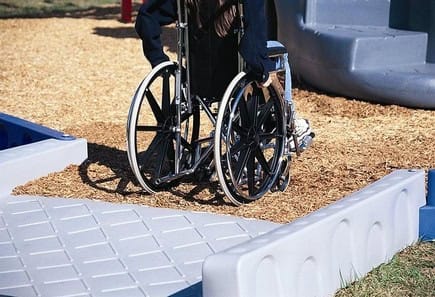
Loose-fill bark remains one of the biggest accessibility barriers in many playgrounds.
While bark is often chosen because it is cheaper initially, it creates ongoing problems for:
Wheelchair users
Walking frame users
Mobility scooters
Elderly carers
Parents with strollers
Disabled children
Neurodiverse users with balance/sensory challenges
Small wheels can easily:
Sink into bark
Become stuck
Lose momentum
Catch on edging
Struggle with uneven compaction
For many users, bark effectively becomes a physical barrier preventing independent participation.
Edges and Transitions Matter
One of the most common places wheels become trapped is at surface transitions.
This includes:
Concrete to bark edges
Rubber to loose-fill surfaces
Pathway joins
Drainage channels
Kerbs
Expansion gaps
Timber edging
Even small height differences can stop a wheelchair or walker suddenly.
This creates:
Fall risks
Tipping risks
Shoulder strain
Equipment damage
Anxiety and loss of confidence
A transition that appears “minor” to an able-bodied designer may create a major barrier for a wheelchair user.
Powerchairs Change the Design Brief
Powerchairs often have:
Smaller front castors
Greater overall weight
Larger turning requirements
Lower ground clearance
More complex movement patterns
When a front castor drops off an edge or becomes trapped, the impact can be significant.
Many powerchair users describe:
Sudden jolting
Chair instability
Wheel spin
Getting stranded
Fear of tipping
Difficulty reversing out safely
These are real-world usability problems rarely reflected in compliance documents.
Independence Depends on Good Design
When wheels become trapped repeatedly, independence disappears.
Children and adults may suddenly require:
Pushing assistance
Lifting
Repositioning
Manual support
Alternative routes
That is not true inclusion.
Good playground design should reduce unnecessary barriers wherever possible.
Children should be able to move confidently and independently through public spaces.
Accessible Surfacing Makes a Huge Difference
Accessible surfacing systems provide:
Smoother movement
Safer circulation
Better traction
Improved manoeuvrability
Reduced fatigue
More predictable navigation
Good surfacing benefits:
Wheelchair users
Mobility aid users
Parents with strollers
Elderly visitors
Children learning to walk
Neurodiverse users
Support workers and carers
Inclusive design benefits entire communities.
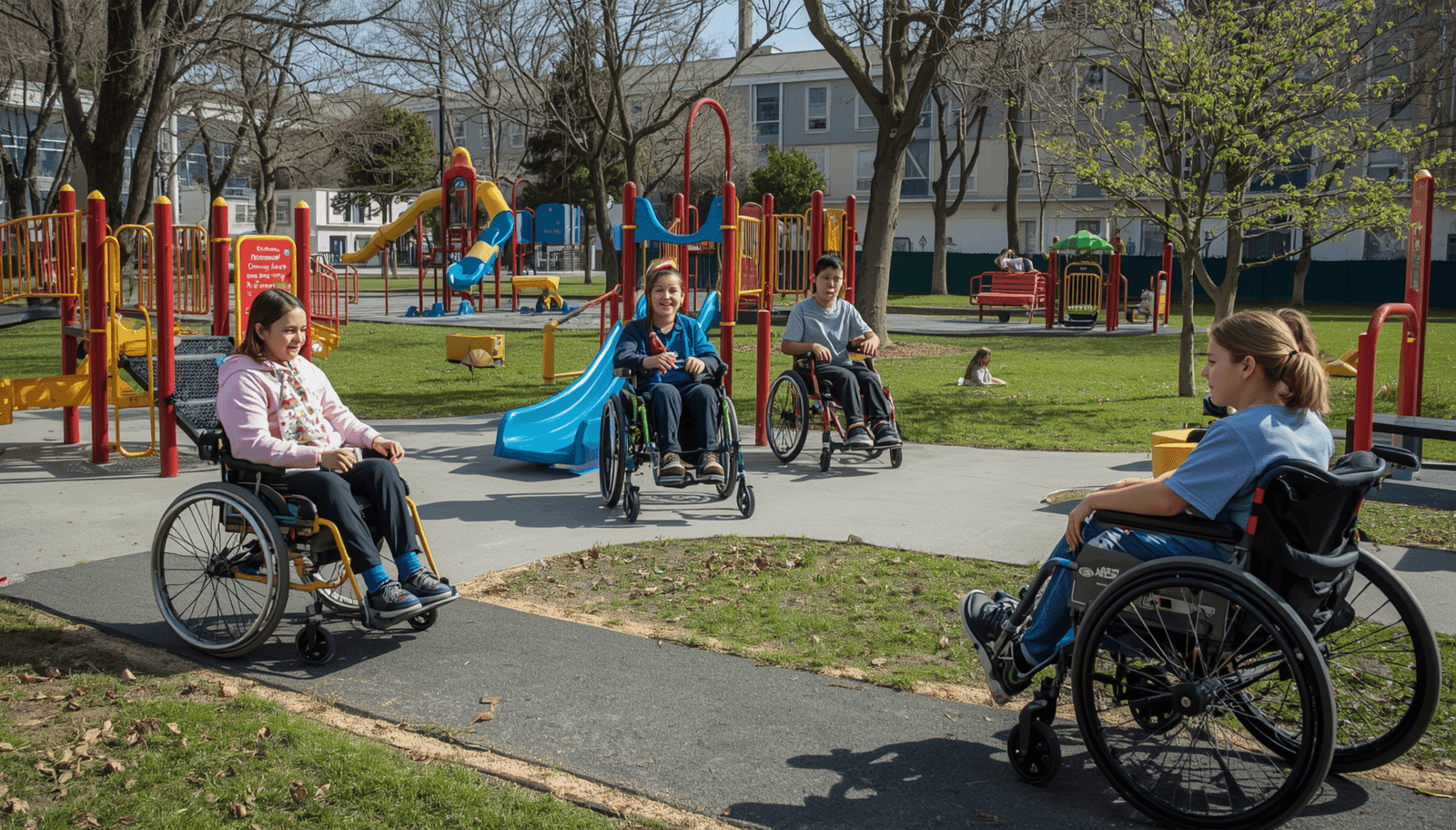
Hardstand and Manoeuvring Space Matter Too
The space around equipment is just as important as the equipment itself.
Wheelchairs and mobility devices require:
Turning space
Stable positioning areas
Smooth approach zones
Predictable circulation routes
Without adequate manoeuvring space, even accessible equipment may remain difficult to use independently.
Accessibility is about the whole environment.
Lived Experience Changes Design
Many accessibility issues involving small wheels are only fully understood through lived experience.
Disabled people and families often identify practical barriers missed during standard planning processes.
Something may appear compliant on paper while functioning very differently in real life.
This is why lived experience input is so important in playground design.
Real users understand:
How wheels behave on different surfaces
Where transitions become dangerous
How fatigue builds over distance
Which layouts feel stressful or unsafe
What genuine independence actually looks like
Inclusion Should Feel Effortless
Children should not have to fight their environment simply to join in play.
Good inclusive playground design should feel natural, safe, and welcoming.
That means paying attention to the small details:
Edges
Gradients
Transitions
Turfacing
Manoeuvring space
Wheel movement
Because sometimes the smallest wheels reveal the biggest accessibility problems.
And true inclusion is built through understanding those real-world experiences.