Sensory Play Equipment
Sensory Play Equipment
Why This Matters
Play is not just physical.
It is sensory.
Children understand the world through what they can feel, see, hear, and experience. Sensory play equipment creates those opportunities.
If a playground only provides physical challenges, it excludes many children.
Inclusive design must provide sensory experiences that support how different children engage with the world.
What Sensory Play Equipment Does
Sensory play equipment is designed to engage multiple senses.
This includes:
Research shows that inclusive playground equipment can support tactile, visual, and auditory experiences, allowing more children to participate meaningfully.
It is not about adding variety.
It is about enabling participation.
Multi-Sensory Play Supports Development
Sensory play is directly linked to development.
It supports:
Motor skills
Cognitive development
Language and communication
Emotional regulation
Sensory activities such as textures, movement, and sound help children explore and understand their environment.
This is not just play.
It is learning.
Different Children Need Different Sensory Input
Children experience sensory input differently.
Some seek:
Movement
Noise
Stimulation
Others need:
Calm
Quiet
Predictability
Inclusive playgrounds must provide a range of sensory experiences, allowing children to choose what works for them.
There is no single “correct” way to play.
Touch-Based Play Is Essential
Tactile play is one of the most important elements.
This includes:
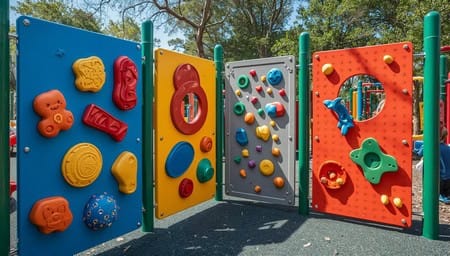
Textured panels
Sand and water play
Interactive surfaces
Tactile features allow children to:
Explore through touch
Understand cause and effect
Engage without needing language
For many children, touch is the primary way they interact with the world.
Movement and Sensory Regulation
Movement is a key part of sensory play.
Activities such as:
Swinging
Spinning
Rocking
Support balance, coordination, and regulation.
Research shows that sensory-rich activities help children regulate their bodies and interact more effectively.
Movement is not optional.
It is essential for many children to feel comfortable enough to play.
Sound Should Be an Option — Not a Requirement
Sound-based equipment can be valuable.
Examples include:
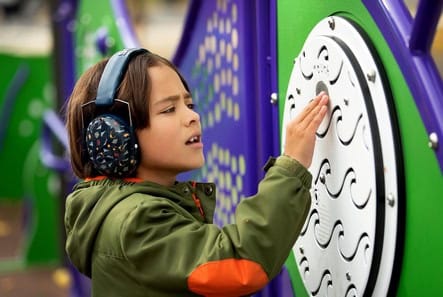
Musical panels
Chimes
Interactive sound features
But not all children use or respond to sound.
Inclusive design must ensure:
Sound is optional
Other sensory inputs are available
If play depends on sound, some children are excluded.
Visual Stimulation Supports Engagement
Visual elements help children understand and engage.
This includes:
Colour
Pattern
Movement
Light
Visual features can:
Attract attention
Show how the equipment works
Encourage interaction.
But they must be balanced.
Too much visual input can overwhelm.
Sensory Play Supports Social Interaction
Sensory equipment is not just individual.
It can create shared experiences.
Children interact through:
Movement
Touch
Sound
Observation
Inclusive playgrounds encourage social interaction and cooperation through shared play experiences.
Sensory play becomes a way to connect.
Provide Both Active and Quiet Sensory Spaces
A balanced playground includes:
Active sensory zones
Calm retreat areas
Some children need:
High stimulation
Others need low stimulation
Design guidance highlights the importance of providing quiet zones alongside active areas to support different needs
Choice is what makes a space inclusive.
Sensory Play Must Be Accessible
Sensory equipment must be reachable and usable.
This means:
Accessible pathways
Appropriate heights
Space for mobility devices
If a child cannot reach the equipment, they cannot use it.
Accessibility and sensory design must work together.
Integration Matters
Sensory equipment should not be isolated.
It should be:
Part of the main play space
Connected to pathways
Integrated into equipment
When sensory play is placed on the edge, it is often underused.
When it is part of the playground, it becomes part of the experience.
Real-World Behaviour
In real playgrounds:
Children move between activities
They follow what interests them
They engage with what feels right
Sensory play must be:
Easy to access
Easy to understand
Part of the flow
If it requires effort to find or use, it will be ignored.
A Lived Experience Reality
From lived experience, the difference is clear.
A space either:
Invites exploration
Or limits it
A child either:
Engages across multiple senses
Or disengages completely
That decision happens quickly.
Sensory Play Is Not an Extra
Sensory play equipment is sometimes treated as an add-on.
It is not.
It is a core part of inclusive design.
Without it:
Some children cannot regulate
Cannot engage
Cannot participate fully
Final Thought
Sensory play equipment creates access in ways traditional equipment cannot.
It allows children to:
Explore
Learn
Regulate
Connect
When playgrounds provide sensory-rich experiences, more children can take part.
When they do not, participation is limited.
Because inclusion is not just about movement.
It is about how children experience the world.