Why Inclusive Equipment Costs More
Why Inclusive Equipment Costs More
Understanding the Real Cost
Inclusive playground equipment often costs more.
This is a fact.
But the reason is simple, it is not just equipment.
It is engineering, safety, usability, and real-world performance built into every part of the design.
Lower-cost equipment may look similar.
But it does not function the same.
Safety Is the Biggest Cost Driver
Safety is not a small add-on.
It is the foundation of inclusive design.
Inclusive equipment must safely support a much wider range of users, including:
Children
Adults
Caregivers
Wheelchair users
Powerchair users
A powered wheelchair with a user can weigh over 200 kg.
That is not a typical playground load.
That is a serious engineering requirement.
Equipment must be designed to:
Handle higher loads
Remain stable under movement
Prevent tipping or imbalance
Support dynamic forces safely
This requires stronger materials, better construction, and more testing.
That is where cost comes from.
Engineering for Real-World Use
Inclusive equipment is not just made stronger.
It is made smarter.
It must:
Allow safe entry and exit
Support assisted use
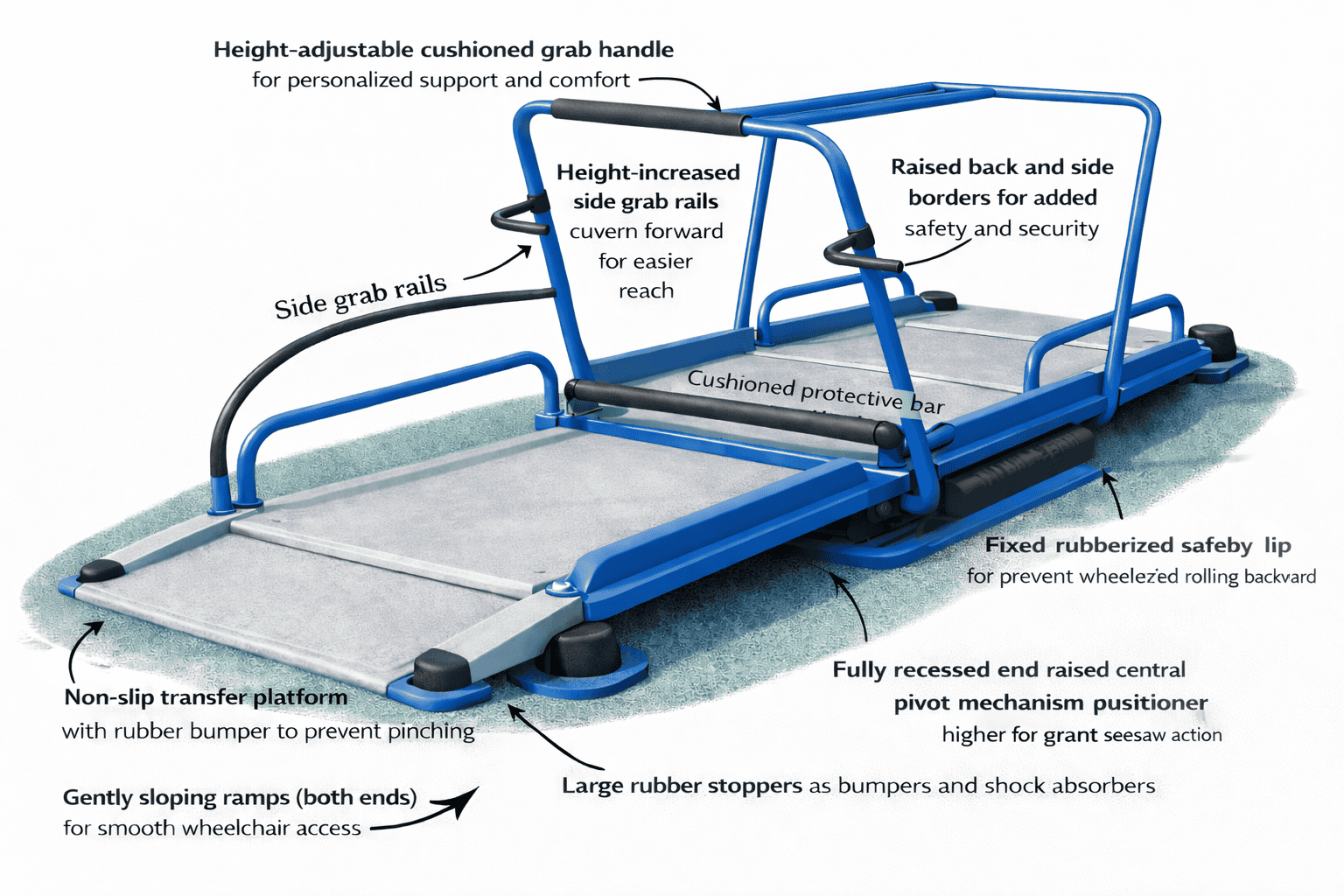
Prevent roll-back or uncontrolled movement
Provide predictable motion
These are not simple features.
They require:
Precision design
Additional components
Higher manufacturing standards
This is why inclusive equipment costs more.
It is solving more problems.
Stability and Structural Design
Standard playground equipment is designed for typical use.
Inclusive equipment must go further.
It must remain stable when:
Weight is unevenly distributed
A wheelchair enters or exits
Multiple users interact at once
For example:
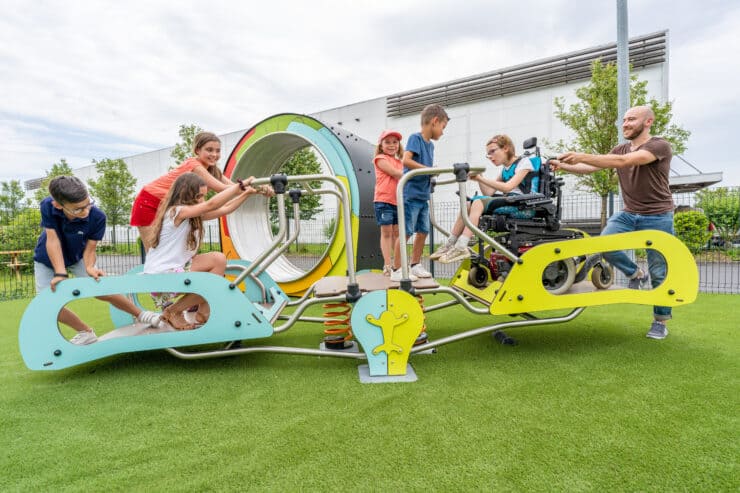
A wheelchair-accessible seesaw must remain balanced under heavy weight, while still providing movement and play value.
That balance does not happen by accident.
It is engineered.
Designing for Independence and Assistance
Inclusive equipment must work in different ways.
It must allow:
Independent use where possible
Assisted use where needed
Safe supervision by carers
This means:
Wider platforms
More space
Clear positioning
Accessible entry points
These features increase both size and complexity.
They also increase the cost.
But they are essential.
More Users, More Requirements
Inclusive equipment is designed for more people.
Not just in number but in diversity.
It must work for:
Different ages
Different abilities
Different mobility devices
Different ways of interacting
Research shows that inclusive playground equipment is more expensive because it includes specialised design features such as ramps, accessible components, and adaptive elements.
This is not optional.
It is what makes it inclusive.
Testing and Compliance
Inclusive equipment must meet strict safety standards.
This includes:
Load testing
Movement testing
Durability testing
Safety compliance
Higher safety standards mean:
More testing
More certification
More design refinement
All of this adds cost.
But it also reduces risk.
Material Quality and Durability
Inclusive equipment is built to last.
It often uses:
Stronger metals
Higher-grade plastics
More durable fixings
Higher-quality materials:
Resist wear
Handle heavier use
Require less replacement
Guidance shows that higher-quality materials increase upfront cost but improve long-term performance and durability.
This is not extra.
It is a long-term value.
The Cost of Doing It Properly
Inclusive design is not about adding a ramp.
It is about creating a system that works.
This includes:
Access
Movement
Use
Safety
Confidence
Each of these adds layers of design.
Each layer adds cost.
But removing those layers removes inclusion.
Why Cheaper Options Fall Short
Lower-cost equipment often reduces:
Structural strength
Stability
Ease of use
Safety features
This leads to:
Equipment that feels unsafe
Equipment that requires assistance
Equipment that is avoided
We often hear:
“The accessible equipment is not being used.”
The reality is:
It is not being used because it is not truly accessible or safe.
Perception Drives Use
Caregivers make decisions instantly.
They look at equipment and decide:
Is this safe?
Can my child use this?
Can I help if needed?
If there is doubt, they walk away.
This is not about cost.
It is about confidence.
Inclusive equipment must feel safe before it is used.
Cost vs Value
The question is not:
“Why does it cost more?”
The question is:
“What does it deliver?”
Higher-cost inclusive equipment:
Gets used
Supports independence
Reduces risk
Encourages return visits
Lower-cost alternatives may:
Sit unused
Create hesitation
Fail in real-world use
A cheaper option that is not used has no value.
Long-Term Investment
Inclusive equipment is a long-term investment.
It delivers:
Higher usage
Better community outcomes
Greater inclusion
Research shows that investing in quality, safety, and durability leads to better long-term value, not higher cost.
This is where the real return lies.
A Lived Experience Reality
From lived experience, the difference is immediate.
You can see it in how quickly a caregiver says yes or no.
You can see it in whether a child gets on the equipment or walks past it.
That decision is not based on price.
It is based on safety.
Final Thought
Inclusive equipment costs more because it does more.
It supports more people.
It carries more weight.
It reduces the risk.
It solves more problems.
A powerchair and user can exceed 200 kg.
Design must respond to that reality.
Because inclusion is not about appearance.
It is about safe, confident, real-world use.
And that cannot be done cheaply.