Real-World Accessibility Failures
Real-World Accessibility Failures
Real-World Accessibility Failures
Accessibility often fails in small, everyday ways.
A playground, park, car park, pathway, toilet, picnic area, or public space may look accessible on paper, but still fail disabled people in real life.
This page is about those failures.
Not to blame, but to help councils, designers, planners, suppliers, and community groups understand what happens when accessibility is treated as a checklist instead of a lived experience.
Why Real-World Accessibility Matters
Accessibility is not just about whether something technically exists.
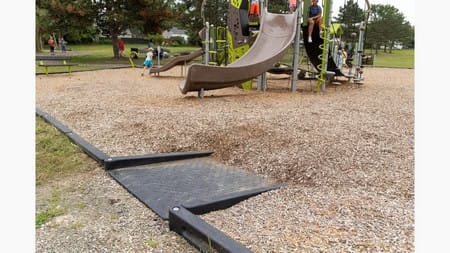
A wheelchair-accessible swing is not truly accessible if the path to reach it is loose bark.
A mobility parking space is not truly accessible if the ground slopes and a wheelchair hoist cannot be used safely.
An accessible toilet is not truly accessible if the door is too heavy, the turning space is blocked, or the pathway to reach it has lips and edges.
A playground is not inclusive if disabled children can see the play but cannot reach it, use it, or take part alongside others.
Real-world accessibility asks a simple question:
Can disabled people actually use this space safely, independently, and with dignity?
The Problem With “Accessible on Paper”
Many public spaces are described as accessible because they include one accessible feature.
But one accessible feature does not make an accessible place.
A playground may have an inclusive carousel, but if it is surrounded by bark or sand, many wheelchair users cannot reach it.
A park may have an accessible toilet, but if the nearest parking is too far away or unsafe to unload from, the toilet may not be usable.
A path may meet a minimum width, but if it has steep crossfall, raised edges, uneven joins, or tight turns, it may still be difficult or unsafe.
Accessibility fails when each item is considered separately instead of as part of a connected journey.
The journey matters.
From the car park, to the path, to the playground, to the toilet, to the seating, to the equipment, every part must work together.
Common Real-World Accessibility Failures
Loose-fill surfacing is one of the most common failures in playgrounds.
Bark, sand, gravel, and loose mulch can stop wheelchairs, walkers, pushchairs, and mobility aids from moving freely. These surfaces may also create problems for children with balance issues, fatigue, sensory sensitivities, or reduced mobility.
Raised timber borders are another common barrier.
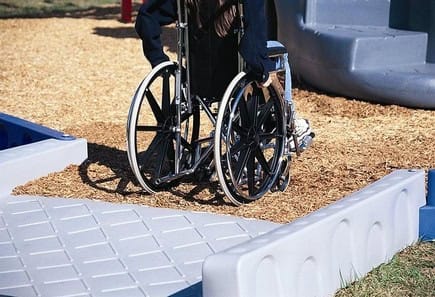
A playground may have an accessible path around the outside, but a raised edge can prevent a wheelchair user from entering the play area. For some families, that small timber edge is enough to turn an inclusive playground into a viewing area only.
Narrow paths and tight turning spaces also create problems.
Manual wheelchair users need space for their arms and shoulders. Powerchair users often need more turning room than people expect. Mobility scooters, walking frames, and larger adaptive equipment also require space to move safely.
Poorly placed accessible equipment is another issue.
Sometimes, inclusive equipment is placed at the edge of a playground, away from the main play activity. This can make disabled children feel separated rather than included.
True inclusion means placing accessible play opportunities where children naturally gather, interact, communicate, and play together.
When One Barrier Cancels Out the Whole Space
A public space can fail because of one overlooked detail.
A lip at a path edge can trap a powerchair castor.
A sloping car park can make a wheelchair hoist unsafe.
A heavy gate can prevent a child or caregiver from entering.
A soft surface can stop a wheelchair before it reaches the equipment.
A missing seat can make the space unusable for a caregiver, grandparent, or disabled adult.
A locked accessible feature can create uncertainty and stop families from even trying.
These are not minor details.
For disabled people, small design failures can remove independence, dignity, safety, and participation.
Accessibility Is Not Just for Wheelchair Users
Real-world accessibility affects many people.
It affects children who use wheelchairs, walkers, crutches, orthotics, or mobility aids.
It affects autistic children who may need predictable routes, quiet areas, safe boundaries, visual communication, and reduced overwhelm.
It affects children with low vision who rely on contrast, clear edges, tactile information, and safe navigation.
It affects deaf and hard-of-hearing children who need visual communication and play opportunities that do not rely only on sound.
It affects parents, grandparents, caregivers, injured adults, pregnant people, and families with pushchairs.
When accessibility fails, it rarely affects just one group.
A poorly designed space excludes many people at the same time.
Why Minimum Compliance Is Not Enough
Minimum compliance can be a starting point, but it should not be the goal.
A design may meet a basic requirement and still fail in everyday use.
Real people do not move through spaces like drawings on a plan.
They turn, reach, reverse, rest, transfer, communicate, avoid hazards, support children, manage fatigue, and deal with weather, crowds, noise, stress, and unpredictability.
A space that only meets minimum measurements may still be difficult, unsafe, or exhausting.
Good inclusive design goes beyond minimum compliance.
It asks what actually happens when disabled children and families use the space.
Lived Experience Shows What Plans Miss
Many accessibility failures are obvious to disabled people because they experience them every day.
A designer may see a small lip.
A powerchair user may see a trap.
A council may see a bark surface.
A wheelchair user may see a barrier.
A supplier may see an inclusive item of equipment.
A disabled child may see something they still cannot reach.
Lived experience helps identify problems before they become expensive mistakes.
It also helps councils and designers understand that accessibility is not theoretical.
It is practical, physical, emotional, and often urgent.
Questions Councils and Designers Should Ask
Before calling a playground or public space accessible, councils and designers should ask whether a disabled child can arrive, enter, move around, play, communicate, rest, use the toilet, and leave safely.
They should ask whether accessible equipment is actually reachable.
They should ask whether the surface supports wheelchairs, walkers, mobility aids, and children with balance or sensory needs.
They should ask whether disabled children can play with other children, rather than beside them or away from them.
They should ask whether a parent or caregiver with a disability can support their child in the space.
They should ask whether the design still works in wet weather, busy periods, and real family situations.
Most importantly, they should ask disabled people before final decisions are made.
The Cost of Getting It Wrong
Accessibility failures cost more than money.
They cost families opportunities.
They cost children friendships, confidence, independence, and participation.
They cost communities the chance to create places where everyone belongs.
When accessibility is added poorly, retrofitting later can be expensive. A path may need rebuilding. Surfacing may need replacing. Equipment may need relocating. Parking may need redesigning.
Getting it right at the start is usually cheaper, safer, and more respectful than fixing avoidable mistakes later.
What Good Accessibility Looks Like
Good accessibility feels connected.
There is safe parking close enough to be useful.
There is a smooth, firm route from the parking area into the playground.
There are no unnecessary lips, traps, raised borders, or loose-fill barriers.
Accessible equipment is placed inside the play space, not hidden at the edge.
There is space to turn, pause, communicate, and move around other people.
There are seating options, shade, toilets, clear signs, visual information, and safe transitions between surfaces.
The space allows disabled children to be part of the action.
That is the difference between access and inclusion.
Our Position
We believe public spaces should be judged by real-world usability, not just by labels, plans, or checklists.
If a disabled child cannot reach the equipment, it is not accessible.
If a wheelchair user cannot cross the surface, it is not accessible.
If a caregiver cannot safely unload, support, rest, or supervise, the space is incomplete.
If accessible features are isolated, locked, poorly placed, or difficult to use, inclusion has not been achieved.
Accessibility should be practical, connected, and based on real life.
Closing Statement
Real-world accessibility failures are often preventable.
They happen when disabled people are not involved early enough, when minimum compliance is treated as enough, or when one accessible feature is used to describe a whole space.
Inclusive design must go further.
It must consider the full journey, the full family, and the full experience of using a public space.
A playground should not simply look inclusive.
It should work for the children and families it claims to include.