Inclusive Playground Equipment
Playground Equipment Designs by CWD
Wheelchair Accessible Inclusive Seesaw 2026
Inclusive play must be safe play.
This wheelchair-accessible seesaw has been designed from lived experience to ensure that children and adults using wheelchairs can enjoy play without increased risk.
A powered wheelchair and rider can weigh over 250 kg.
In real playground use, it may take multiple children on the opposite side to counterbalance that weight. If a child steps or jumps off unexpectedly, the sudden loss of counterweight can cause the wheelchair user to land heavily.
This design directly addresses that risk through:
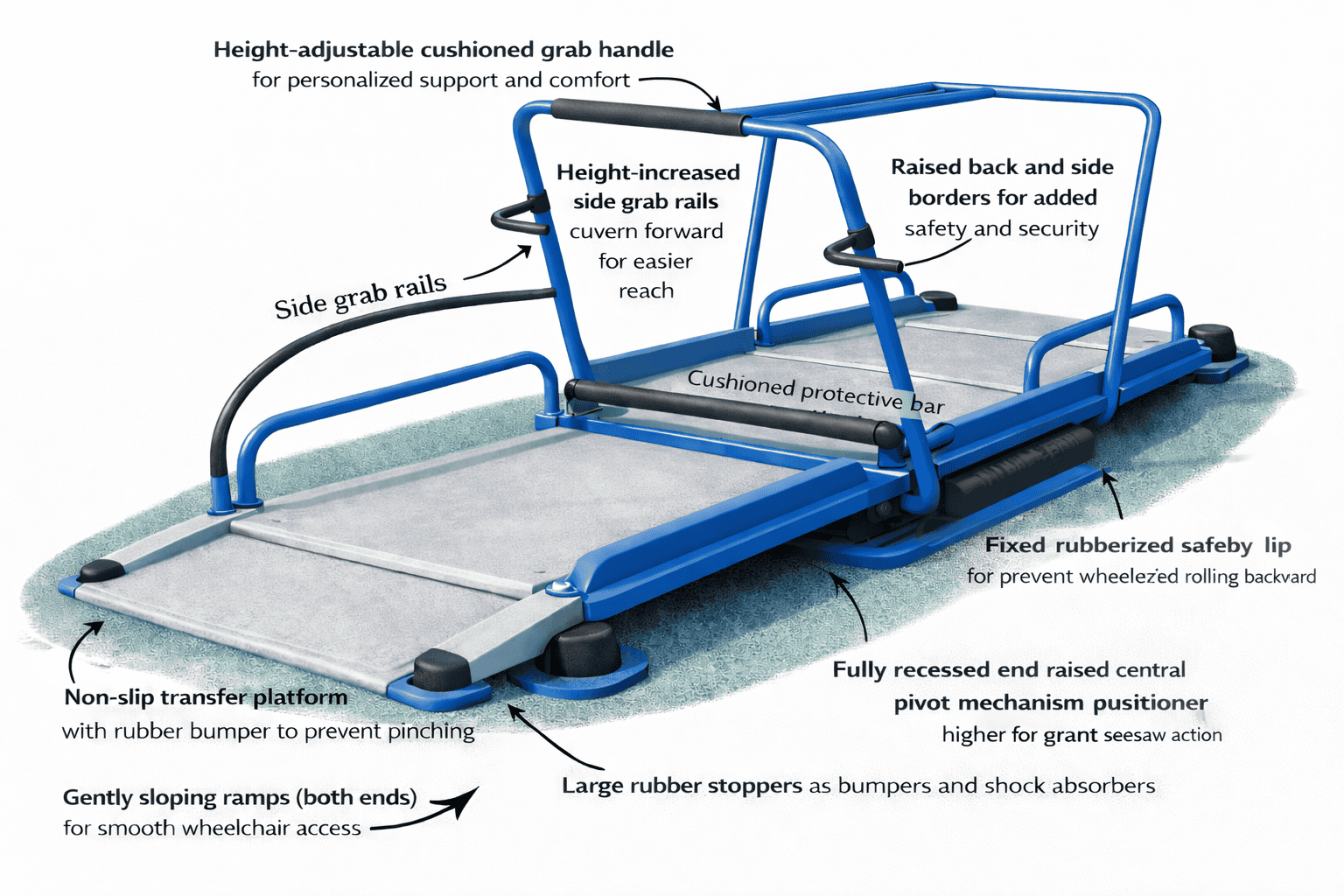
Controlled pivot height for smoother movement
Shock absorption and rubber stoppers
A fixed raised rubberised lip behind the rear wheels to prevent roll-back
A fully recessed pivot mechanism to remove pinch points
The result is a seesaw that supports shared, inclusive play, while prioritising safety, dignity, and real-world use.
This wheelchair-accessible seesaw has been developed to meet the practical safety requirements of inclusive public play spaces.
Unlike standard seesaw designs, this equipment has been engineered to accommodate significantly higher loads, recognising that powered wheelchairs and users can exceed 250 kg. In public playground environments, counterbalancing this weight often relies on multiple children whose behaviour can be unpredictable.
The design incorporates key safety features to mitigate risk associated with sudden loss of counterweight, including:
A raised pivot point to reduce impact forces
Integrated shock absorption and rubber stoppers
A fixed rear roll-back prevention lip for wheelchair stability
A fully recessed pivot mechanism to eliminate pinch and entrapment hazards
In addition, the central riding area with grab posts enables shared play, supporting social inclusion and interaction between disabled and non-disabled children.
This approach aligns with best-practice principles for inclusive design, public safety, and equitable access, ensuring that disabled users are not exposed to higher levels of risk than their peers.
Lower cost does not always mean lower risk.
Wheelchair-accessible seesaws that are offered at significantly lower price points often achieve those savings by reducing materials, simplifying mechanisms, or omitting safety features.
This design costs more because it includes:
Engineering for higher dynamic loads, not minimum compliance
Shock absorption to manage sudden force changes
Roll-back prevention for wheelchair stability
A recessed pivot mechanism to reduce injury risk
Additional steel, rubber, and fabrication for durability and safety
In public playgrounds where equipment is unsupervised and used by people of all ages and abilities, designs must anticipate worst-case scenarios rather than ideal use.
The additional investment reflects:
Reduced injury risk
Greater long-term durability
Improved user confidence
Better alignment with inclusive design principles
Inclusion should never be achieved by lowering safety standards. This design ensures that accessibility, safety, and enjoyment are delivered together.