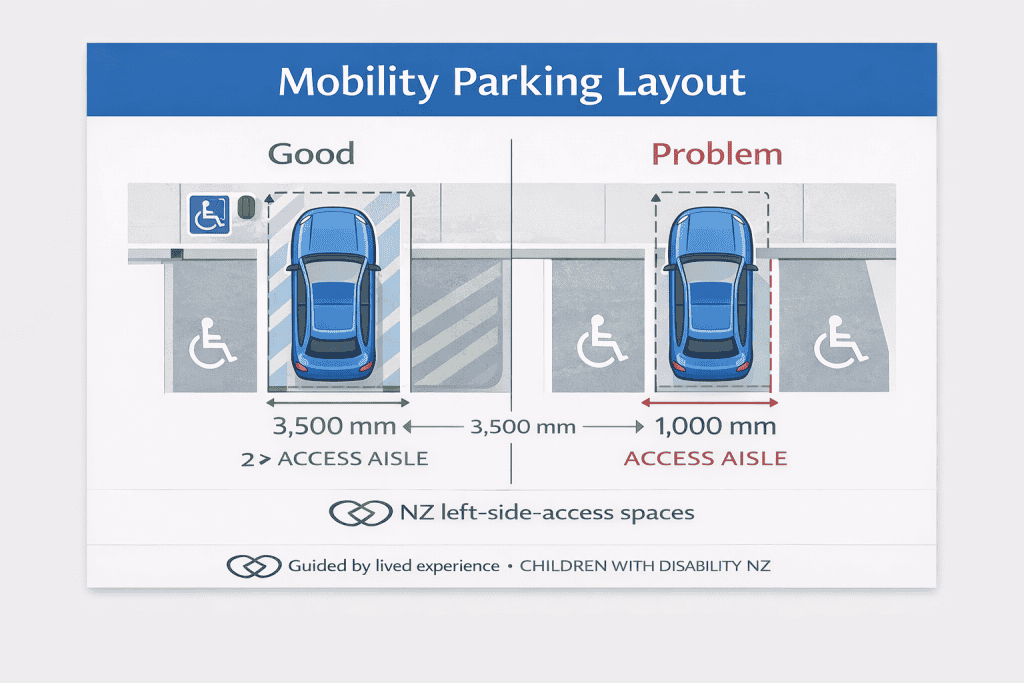
Mobility Parking Design Guide
Mobility Parking Design Guide
Why This Matters
Mobility parking is not just about a car space.
It is the first point of access.
If parking does not work, the playground does not work.
For many families, the decision to stay or leave is made before they even get out of the vehicle.
Inclusive design must start here.
Mobility Parking Is Part of the Journey
Accessibility does not begin at the playground.
It begins when a person arrives.
Mobility parking must connect directly to:
Pathways
Entrances
Play spaces
Guidance requires an accessible route from the parking space to the destination that is safe, direct, and free from obstacles
If that connection fails, everything that follows fails.
Standard Dimensions vs Real Use
New Zealand standards such as NZS 4121 specify accessible parking spaces at approximately:
3.5 metres wide
5.0 metres long
This is wider than a standard car park.
But real-world use often requires more.
Why?
Because vehicles are not standard.
And people are not standard.
Vehicles Need Space — Not Just Width
Accessible parking must allow for:
Wheelchair transfers
Hoist access
Side and rear entry
Many wheelchair vans require:
Full side access
Clear space beside the vehicle
Flat ground for hoist operation
If that space is not available, the park cannot be used safely.
Flat Ground Is Critical
Slope is one of the most overlooked issues.
Standards recommend very low gradients (around 1:50) to ensure safety
But in real life:
Even slight slope creates risk
Hoists become unstable
Wheelchairs roll unexpectedly
Flat ground is not a preference.
It is essential.
Surface Quality Affects Safety
Mobility parking surfaces must be:
Firm
Stable
Non-slip
Guidance highlights that stable surfaces such as concrete or asphalt are preferred to support wheelchair use
Loose or uneven surfaces create:
Instability
Trip hazards
Wheelchair movement issues
If the surface is not reliable, the space is unsafe.
Location Matters
Accessible parking must be:
Close to the destination
On the shortest possible route
Free from hazards
Guidance clearly states parking should be located as close as possible to the entrance or facility
Distance matters.
Energy matters.
Safety matters.
Avoid Dangerous Routes
A common failure is forcing users to:
Travel behind parked cars
Cross traffic
Navigate unclear paths
Accessible routes must be:
Direct
Safe
Clearly defined
No one should have to risk their safety to reach a playground.
Kerbs, Lips, and Transitions
One of the biggest real-world failures is the transition from parking to the pathway.
Common issues include:
Raised kerbs
Uneven lips
Poorly designed ramps
Even small height changes create barriers.
A wheelchair or mobility device cannot safely cross an uneven edge.
Design must ensure:
Flush transitions
Smooth connections
No unexpected level changes
Design for Hoists and Side Access
Many wheelchair users rely on vehicle hoists.
These require:
Flat, stable ground
Clear side space
No obstructions
If a hoist cannot deploy safely:
The user cannot exit the vehicle
The parking space is unusable
This is not a minor issue.
It is a complete failure of access.
Width Alone Is Not Enough
A wider space is important.
But width without usability is meaningless.
Design must consider:
Door opening space
Ramp deployment
Hoist clearance
If a user cannot safely get in or out, the dimension does not matter.
Clear Marking and Visibility
Accessible parking must be clearly identifiable.
This includes:
High-contrast markings
Recognisable symbols
Clear signage
Guidance highlights the use of the International Symbol of Access and visible markings to prevent misuse.
If a space is not clearly marked, it will be misused.
Real-World Behaviour
In real life:
People are in a hurry
Spaces are misused
Conditions are not perfect
Design must account for this.
It must work when:
The car park is busy
Surfaces are wet
Space is limited
If it only works in ideal conditions, it will fail.
The Problem With Minimum Standards
Standards provide a baseline.
But they do not reflect:
Large vehicles
Powerchairs
Hoist systems
Real-world conditions
Designing to minimums creates risk.
Designing for real use creates inclusion.
A Lived Experience Reality
From lived experience, the difference is immediate.
You either:
Park and get out easily
Or struggle before you even begin
You either:
Feel safe
Or feel at risk
That moment defines the entire visit.
Mobility Parking Is Not Optional
Mobility parking is not a convenience.
It is essential infrastructure.
Without it:
People cannot access the space
Families cannot participate
Inclusion fails before it starts
Final Thought
Mobility parking is the first test of accessibility.
If it works, people move forward.
If it fails, they leave.
A 3.5 metre space may meet the standard.
But real inclusion requires:
Flat ground
Clear access
Safe transitions
Enough space to function
Because accessibility does not begin at the playground.
It begins in the car park.
And if that fails, everything else does too.