Designing for Independence
Designing for Independence
Designing for Independence from Lived Experience
True inclusion is not simply about allowing disabled children to enter a playground.
It is about creating spaces where children can participate with dignity, confidence, freedom, and as much independence as possible.
For many disabled children and families, independence is one of the most overlooked aspects of playground design.
A playground may technically appear accessible while still requiring constant assistance, lifting, supervision, or support to use basic features.
That is not true inclusion.
Independence Creates Confidence
For children, independence is deeply connected to:
• confidence
• self-esteem
• decision-making
• social development
• exploration
• risk assessment
• identity
• belonging
Every child wants opportunities to make choices, explore freely, and participate alongside their peers.
Disabled children are no different.
Inclusive playgrounds should not be designed around dependence.
They should be designed around participation.
Accessibility Is More Than Entry
One of the biggest misconceptions in playground design is the idea that accessibility begins and ends with wheelchair access into the playground.
Real accessibility goes much further.
Can a child:
• reach the equipment independently?
• move safely around the playground?
• transfer without excessive assistance?
• communicate easily?
• participate socially?
• make choices about where they want to play?
• regulate themselves when overwhelmed?
• access seating, pathways, and rest areas comfortably?
If the answer is no, then the playground may still be excluding people even if it technically meets compliance standards.
The Problem with “Help Required”
Too much supposedly accessible equipment still relies heavily on adult assistance.
This can include:
• lifting children manually
• pushing wheelchairs across unsuitable surfaces
• transferring children onto equipment
• requiring keys or harness systems
• navigating raised borders or inaccessible pathways
• relying on carers to make equipment usable
While support may sometimes be needed, good inclusive design should aim to reduce unnecessary dependence wherever possible.
Children should be able to participate with dignity, not feel like a burden.
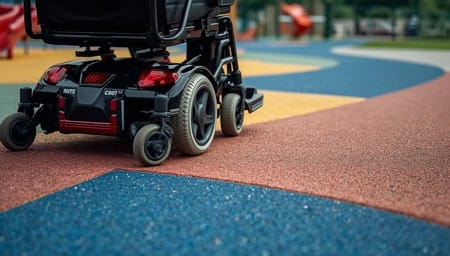
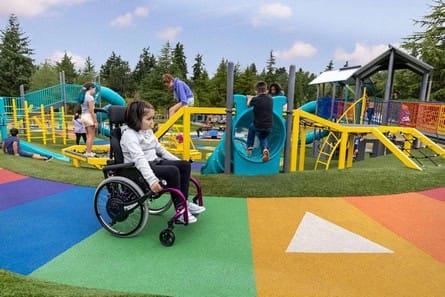
Accessible Surfacing Is Essential
Independence is impossible without good surfacing.
Loose-fill bark, sand, and unstable surfaces can immediately remove independence for many users.
For wheelchair users, mobility aid users, walking frame users, and some neurodiverse children, bark often becomes a physical barrier rather than a play surface.
Accessible surfacing systems help create:
• smoother movement
• safer circulation
• reduced fatigue
• improved confidence
• easier wheelchair navigation
• better access for carers and families
• safer transitions between spaces
The surface around equipment is often just as important as the equipment itself.
Inclusive Equipment Should Be Shared
We strongly believe inclusive playground equipment should be designed for everybody to use together.
Children do not want to feel separated or singled out.
Modern inclusive equipment allows:
• side-by-side play
• shared experiences
• social interaction
• mixed-ability participation
• natural inclusion within the playground environment
No keys.
No segregation.
No special “disabled-only” area.
Just children playing together.
Independence for Families Matters Too
Inclusive design should not focus only on the child.
Families and carers also need independence, comfort, and dignity within public spaces.
This includes:
• accessible pathways
• mobility parking
• seating areas
• shade and shelter
• accessible toilets
• smooth circulation routes
• safe transitions
• good visibility across the playground
If a family cannot comfortably access or navigate the space, then true inclusion has still not been achieved.
Designing for Neurodiversity
Independence also matters for autistic children, ADHD children, and other neurodiverse users.
Predictable layouts, sensory-aware spaces, quiet retreat areas, clear sightlines, and opportunities for movement regulation can all improve a child’s ability to navigate and participate independently.
Good inclusive design recognises that independence looks different for different people.
Lived Experience Changes Design
Many accessibility problems only become obvious through lived experience.
Something may appear compliant on paper while functioning very differently in real life.
Disabled people and families often identify practical barriers such as:
• difficult gradients
• trapped castors
• inaccessible transitions
• excessive transfer requirements
• sensory overload
• unsafe circulation spaces
• equipment that cannot realistically be used independently
That is why lived experience should always be part of inclusive playground planning.
Independence Is About Dignity
At its core, designing for independence is about dignity.
Every child deserves opportunities to:
• make choices
• explore freely
• interact socially
• challenge themselves
• experience joy
• feel included within their community
Inclusive playgrounds should not simply allow disabled children to “be present.”
They should empower children to participate meaningfully, confidently, and independently wherever possible.
Because real inclusion is not about being allowed to enter a space.
It is about being able to truly belong within it.