Inclusive Social Play Without Sound
Inclusive Social Play Without Sound
Why This Matters
Play is social.
But not all social play relies on sound.
Many children cannot rely on spoken communication. This includes deaf and hard-of-hearing children, non-verbal children, and children who communicate in different ways.
If a playground depends on sound to connect people, it excludes them.
Inclusive design must support social interaction without requiring speech.
Play Does Not Require Words
Children communicate in many ways.
This includes:
Gesture
Movement
Eye contact
Shared activity
Facial expression
Research shows that play helps children develop communication and social skills, even when verbal communication is limited.
Playgrounds should support these natural forms of interaction.
Not replace them with barriers.
Design for Interaction, Not Instruction
Some playgrounds rely on instructions or verbal cues.
“Push here”
“Wait your turn”
“Follow this rule”
This creates barriers for children who do not process or use spoken language.
Inclusive design should:
Show how to use the equipment
Encourage interaction through design
Allow play to happen naturally
If a child needs instructions to participate, the design is already limiting them.
Shared Play Creates Communication
The most powerful form of social play is shared experience.
Children connect through:
Playing side by side
Taking turns
Mirroring actions
Watching and copying
Inclusive playgrounds should include equipment that naturally supports shared use.
Research shows that inclusive play environments encourage interaction and social development across different abilities
Play itself becomes the communication.
Visual Communication Is Key
When sound is not available, visual information becomes critical.
This includes:
Clear visibility of how the equipment works
Seeing other children play
Recognising patterns and movement
Design should allow children to understand:
Where to go
What to do
How to join in
Without needing to hear instructions.
Movement as Communication
Movement is one of the most universal forms of communication.
Swings, seesaws, and spinning equipment allow children to:
Respond to each other
Create rhythm
Share timing
These interactions do not require words.
They create connections through action.
Face-to-Face Interaction Matters
Some playground designs unintentionally block social interaction.
Children face away from each other
Equipment separates users
Positions limit eye contact
Inclusive design should support:
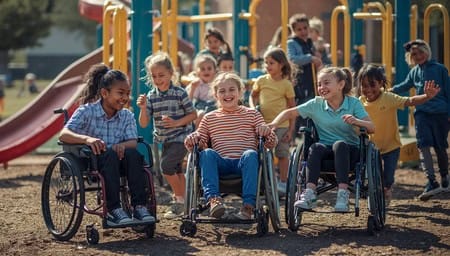
Face-to-face positioning
Side-by-side play
Opportunities to see and respond to others
Social connection occurs when children can see one another.
Avoid Over-Reliance on Sound-Based Play
Some equipment depends on sound to create engagement.
Musical panels
Audio-based games
Call-and-response features
These can be valuable, but they should not be the only option.
If a child cannot hear the interaction, they are excluded.
Inclusive playgrounds provide multiple ways to engage.
Support Different Communication Styles
Not all children communicate in the same way.
Some may:
Use gestures
Use communication boards
Use assistive devices
Use minimal interaction
Inclusive design must allow for all of these.
Research highlights that inclusive environments should support diverse ways of interacting, including non-verbal communication and structured play.
There is no single “correct” way to play.
Design for Confidence, Not Confusion
Children need to feel confident joining in.
If a play situation relies on:
Verbal coordination
Complex rules
Unclear expectations
It becomes harder to participate.
Inclusive design should make it easy to:
Observe
Understand
Join
Without needing explanation.
Social Play Without Pressure
Not all children want high levels of interaction.
Some prefer:
Parallel play (playing alongside others)
Watching before joining
Short interactions
Inclusive playgrounds should support:
Low-pressure social opportunities
Flexible engagement
Choice in how to participate
Social play should be available
not forced.
Layout Supports Interaction
Social connection is influenced by layout.
Design should:
Bring children together
Avoid isolation
Create shared spaces
Research shows that inclusive playgrounds must consider both physical and social accessibility to support real participation.
If children are separated by design, interaction is reduced.
Real-World Behaviour
In real playgrounds:
Children do not announce themselves
They do not ask permission
They join in through action
Design must support this natural behaviour.
If joining requires explanation, it creates a barrier.
A Lived Experience View
From lived experience, you can see immediately whether a space supports social play.
You see:
Whether children can approach each other
Whether they can play together without speaking
Whether they feel included
If interaction depends on sound, some children are left out.
If it works without sound, everyone can join.
Final Thought
Inclusive social play does not depend on words.
It depends on the design.
When playgrounds support visual, physical, and shared interaction, communication happens naturally.
When they rely on sound, they exclude.
Because inclusion is not about how children communicate.
It is about whether the environment allows them to connect.