Surfacing Costs Comparison
Playground Surfacing Costs Comparison
Whole-of-Life Cost vs Upfront Cost
A 200 sqm Playground Surface Comparison
When surface options are assessed only on upfront price, accessibility and long-term value are often overlooked. A whole-of-life approach provides a clearer picture of cost, performance, and community benefit.
Below is a simplified comparison using a 200 sqm playground area.
Upfront Cost Comparison (Indicative)
| Surface Type | Typical Upfront Cost (200 sqm) |
|---|---|
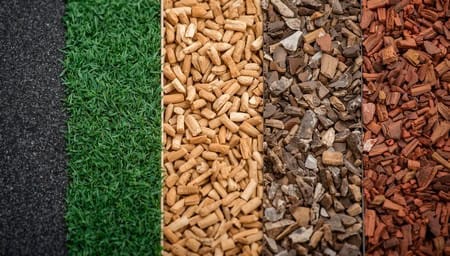
| Loose bark / soft fill | Lower upfront cost |
| Engineered hardstand / accessible surfacing | Higher upfront cost |
At first glance, bark or loose fill appears attractive from a budget perspective. However, upfront cost represents only a small portion of the total cost over the life of a playground.
Ongoing Maintenance Costs
Loose Bark / Soft Fill
Over time, loose surfaces require:
Regular top-ups due to displacement and breakdown
Raking and redistribution
Replacement after weather events
Edge repairs where bark migrates onto paths
Increased labour costs
For a 200 sqm area, maintenance can occur multiple times per year, with costs recurring annually for the life of the playground.
Accessible Hardstand
Engineered hardstand surfaces typically require:
Periodic inspection
Occasional cleaning
Localised repair if damaged
Maintenance frequency is significantly lower, and costs are more predictable.
Accessibility and Functional Value
Loose surfaces often:
Prevent independent access for wheelchair users
Require assistance for people using mobility aids
Limit who can use the space and how often
Reduce the usable lifespan of inclusive equipment
Hardstand surfaces:
Support independent access for manual and powered wheelchairs
Remain usable in wet conditions
Allow full use of inclusive equipment
Enable all users to share the same space
When accessibility is compromised, the functional value of the playground is reduced — even if the equipment itself is inclusive.
Risk and Liability Considerations
Loose surfaces can:
Become uneven or unstable
Create trip hazards
Mask changes in level
Increase fall and injury risk for some users
Engineered surfaces:
Provide consistent performance
Reduce trip and mobility hazards
Support predictable movement patterns
Improve overall safety outcomes
Reducing injury risk also reduces long-term liability and reputational risk.
Whole-of-Life Cost Summary (Conceptual)
Over a 15–20 year period for a 200 sqm area:
Loose bark may have a lower initial cost but higher cumulative maintenance and accessibility costs.
Hardstand may have a higher upfront cost but lower maintenance, greater usability, and better long-term value.
In many cases, the total cost over the life of the playground becomes comparable or lower when accessibility and maintenance are accounted for.
Value Beyond Dollars
Whole-of-life value also includes:
Independence for disabled users
Reduced reliance on carers
Broader community use
Longer usable lifespan of inclusive equipment
Better alignment with inclusion and equity objectives
These benefits are not easily measured in dollars but are central to inclusive public space outcomes.
Key Principle
A surface that limits who can use a playground reduces its value — regardless of how much money was saved upfront.
Designing for accessibility from the beginning delivers better outcomes for councils, communities, and users over the life of the asset.
“Upfront savings can result in long-term exclusion. Whole-of-life thinking delivers real value”.


What’s the key takeaway?
If people cannot move independently across a surface, the space is not accessible — no matter how inclusive the equipment may be.