Accessible BBQs & Picnic Areas
Accessible BBQs & Picnic Areas
Why BBQ and Picnic Areas Matter in Inclusive Playgrounds
Playgrounds are not just about play. They are about people coming together.
BBQ and picnic areas are where families gather, celebrate, share food, and spend time together. For many communities, these spaces are just as important as the playground itself.
If these areas are not accessible, disabled children and adults are excluded from one of the most social and meaningful parts of the experience.
Inclusive playground design must extend beyond play equipment and into shared spaces.
Inclusion Means Sitting and Eating Together
A truly inclusive space allows everyone to participate equally.
That means:
Sitting together at the same table
Sharing meals without separation
Being part of the group, not placed aside
Traditional picnic tables often create barriers for wheelchair users due to fixed seating and a lack of access space.
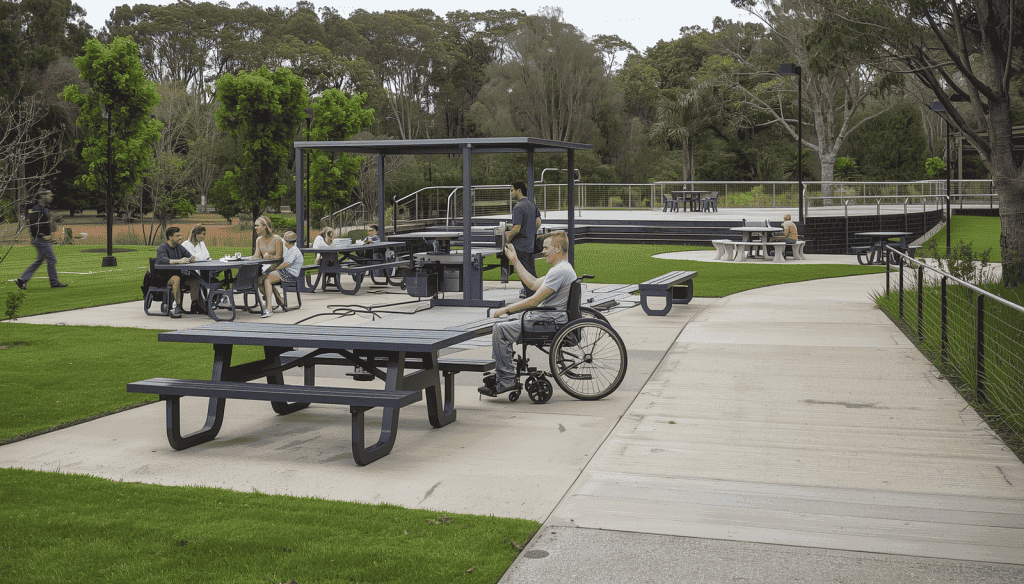
Accessible design removes those barriers by allowing wheelchair users to sit within the group, not at the end or outside it.
Inclusion is about connection.
Accessible Picnic Tables Are Essential
Accessible picnic tables are designed to accommodate wheelchair users.
These typically include:
Extended tabletops
Open spaces underneath
Side or end access points
This allows a wheelchair user to roll directly into the table space and sit alongside others.
Modern designs even allow users to sit in the middle of the table, not just at the ends, improving inclusion and social interaction.
A table that everyone can use creates a shared experience.
The Ground Surface Matters Just as Much
A perfectly designed table is useless if it sits on inaccessible ground.
BBQ and picnic areas must be placed on:
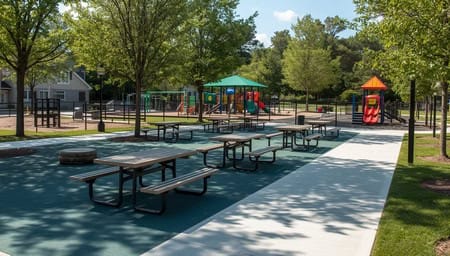
Firm, stable surfaces
Level ground
Accessible pathways
Loose surfaces, such as bark, sand, or uneven grass, make it difficult or impossible for wheelchair users to access or use the space.
Accessible design always considers the full journey, not just the destination.
BBQ Design Must Be Reachable and Safe
Public BBQ facilities must be usable from a seated position.
This means:
Controls and cooking surfaces must be within reach
Warning lights and indicators must be visible
Clear space must be provided around the unit
Accessible BBQ cabinets are designed to allow users to safely reach and operate them while seated.
If a person cannot use the BBQ safely, they are excluded from the activity.
Clear Space Around BBQ Areas
BBQ areas must provide enough space for real-world use.
This includes:
Room to approach and position a wheelchair
Space for turning and manoeuvring
Clear access paths free from obstacles
Guidance emphasises the importance of continuous, unobstructed pathways and manoeuvring space around BBQ facilities.
Crowded or tight layouts create stress, risk, and exclusion.
Safety Around Heat and Cooking Areas
BBQ areas introduce additional risks.
Design must consider:
Protection from hot surfaces
Safe distances between users
Clear zones to prevent accidental contact
Features such as raised edges or protective barriers can help reduce the risk of burns, particularly for children.
Safety is not optional; it must be built into the design.
Seating Variety Supports Different Needs
Not everyone can use the same type of seating.
Accessible BBQ and picnic areas should include:
Accessible picnic tables
Standard seating
Seating with backrests and armrests
Space for wheelchairs beside seating
Providing a mix of options allows people to choose what works best for them.
One type of seating does not suit everyone.
Shelter, Shade, and Comfort
BBQ and picnic areas are often used for extended periods.
These spaces should include:
Shade from sun exposure
Shelter from rain and wind
Comfortable seating
Access to drinking water
Without these features, people may not be able to stay long enough to enjoy the space.
Comfort supports inclusion.
Connection to the Playground
BBQ and picnic areas must be connected to the playground, not separated from it.
They should be:
Located within or adjacent to the play space
Connected by accessible pathways
Positioned to allow supervision of children
Parents and caregivers need to stay close to children while still participating in social activities.
Separation creates barriers. Connection creates inclusion.
Accessible Routes to and Within the Area
The journey to the BBQ area must be accessible.
This includes:
Wide, level pathways
Smooth transitions between surfaces
Clear signage and wayfinding
Ramps should be used where needed, with gentle gradients that enable safe, independent access.
An accessible BBQ area that cannot be reached is not accessible.
Maintenance and Cleanliness
BBQ areas must be maintained to remain usable.
This includes:
Regular cleaning to remove grease and debris
Safe, non-slip surfaces
Working equipment
Clear pathways
Poor maintenance can quickly turn an accessible space into a hazardous one.
Accessibility must be maintained over time.
Common Mistakes
Accessible BBQ and picnic areas often fail due to simple oversights.
Tables that cannot accommodate wheelchairs
BBQs that cannot be reached from a seated position
Soft or uneven ground
Crowded layouts with no manoeuvring space
Lack of shade or shelter
Poor connection to the playground
These issues prevent people from fully using the space.
A Lived Experience View
From lived experience, BBQ and picnic areas are where inclusion is most visible.
This is where families gather, where children eat together, where social moments happen.
If a disabled child or adult cannot sit at the table, cannot reach the BBQ, or cannot move through the space, they are excluded from the shared experience.
Inclusive design ensures they are included.
Final Thought
Accessible BBQ and picnic areas are not just about eating.
They are about belonging.
They are where social inclusion becomes real.
A well-designed space allows everyone to gather, share, and participate equally.
Because inclusion is not just about play, it is about being together.