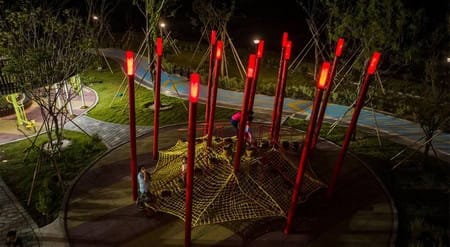
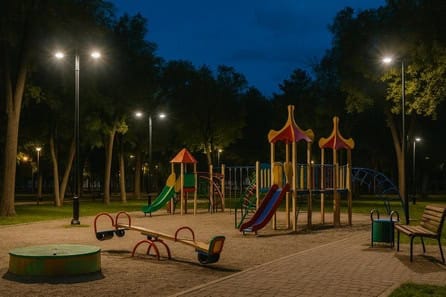
Lighting & Safety in Play Spaces
Lighting & Safety in Play Spaces
Why Lighting Matters in Inclusive Playgrounds
Lighting is about more than visibility. It is about safety, confidence, and whether a space feels usable at all.
Many playgrounds are designed for daytime use, but real life does not always fit into daylight hours. Families arrive late in the afternoon. Winter days are shorter. Caregivers may need safe access in low light.
Without proper lighting, a playground can quickly become unsafe, difficult to navigate, and unwelcoming.
Inclusive design must consider how a space works in all light conditions, not just when the sun is shining.
Lighting Supports Safety and Visibility
The primary role of lighting is to make hazards visible.
Good lighting helps people see:
Steps and level changes
Edges of pathways
Play equipment boundaries
Entrances and exits
Seating and rest areas
Outdoor lighting guidance consistently highlights the importance of illuminating hazards such as steps and edges to reduce the risk of trips and falls.
In a playground, this becomes even more important due to movement, uneven surfaces, and unpredictable behaviour.
If people cannot clearly see where they are going, the risk increases immediately.
Lighting Extends Safe Use of the Space
Lighting allows playgrounds to be used safely beyond daylight hours.
Well-lit public spaces are shown to:
Improve safety
Encourage positive use
Reduce the risk of accidents
Increase community confidence
In New Zealand public spaces such as skateparks, lighting has been shown to improve safety, allow people to use facilities into the evening, and maintain visibility and reduce risk.
Playgrounds are no different.
Lighting turns a space from “closed” into “usable”.
Pathways Must Always Be Clearly Lit
Accessible pathways are critical, and lighting must support them.
Paths should be:
Clearly visible from end to end
Evenly lit without dark patches
Free from glare or harsh shadows
If a pathway disappears into darkness, it becomes a barrier.
Lighting should guide movement naturally, helping users understand where to go without confusion or hesitation.
Avoid Glare and Harsh Lighting
More light is not always better.
Poor lighting design can create:
Glare that makes it harder to see
Deep shadows that hide hazards
Uneven lighting that causes confusion
Inclusive lighting should be:
Soft but effective
Evenly distributed
Designed to reduce contrast extremes
People with visual sensitivities, low vision, or neurological conditions can be particularly affected by harsh or inconsistent lighting.
Good lighting should support visibility, not fight it.
Lighting Around Equipment and Play Zones
Lighting should focus on key activity areas.
This includes:
Swings and moving equipment
Climbing structures
Slides and elevated areas
Sensory play zones
These are areas where movement is highest, and risk is greatest.
Lighting must allow users and caregivers to clearly see what is happening at all times.
Entrances, Car Parks, and Surrounding Areas
Lighting must begin before the playground.
Access routes such as:
Car parks
Mobility parking spaces
Footpaths
Entrances
must all be well lit.
A safe playground with a poorly lit entrance is still unsafe.
People need to feel confident from the moment they arrive.
Support Supervision and Social Safety
Lighting is not just about physical safety; it also supports social safety.
Well-lit spaces:
Improve visibility for caregivers
Reduce hidden or isolated areas
Discourage unsafe behaviour
Parents and caregivers must be able to clearly see children across the space.
Good lighting creates a sense of openness and security.
Design for Consistency
Lighting should be consistent across the entire playground.
There should be:
No sudden dark areas
No overly bright spots
Smooth transitions between zones
Consistency helps users understand the space and move through it safely.
Unpredictable lighting creates uncertainty and risk.
Accessibility of Lighting Infrastructure
Lighting design must not create new barriers.
This means:
Light poles must not obstruct pathways
Fixtures must not reduce the clear movement space
Cables and fittings must be safely installed
Outdoor lighting systems must be carefully planned to ensure safe installation, a reliable power supply, and long-term reliability.
Infrastructure should support access, not interfere with it.
Energy Efficiency and Sustainability
Modern playground lighting often uses LED systems.
These provide:
Lower energy use
Longer lifespan
Better light quality
Reduced maintenance
Sustainable lighting solutions allow councils to maintain safe spaces without excessive cost.
Efficiency supports long-term usability.
Maintenance Is Critical
Lighting that does not work is worse than no lighting at all.
Broken lights create:
Unexpected dark areas
False sense of security
Increased risk
Regular maintenance must ensure:
The lights are functioning
Fixtures are clean
Systems are reliable
Accessibility depends on consistency.
Common Mistakes
Lighting often fails due to poor planning.
Uneven lighting with dark patches
Overly bright lights are causing glare
Poorly lit pathways
No lighting at entrances
Light poles are blocking access
Lack of maintenance
These issues reduce safety and usability.
A Lived Experience View
From lived experience, lighting can be the difference between confidence and hesitation.
A well-lit space feels safe, predictable, and usable.
A poorly lit space feels uncertain and risky.
For disabled users, especially those with mobility or vision challenges, lighting directly affects independence.
If you cannot see clearly, you cannot move confidently.
Final Thought
Lighting is not just about seeing.
It is about feeling safe, moving confidently, and using a space without fear.
Inclusive playgrounds must work in all conditions, including low light.
Because accessibility does not end when the sun goes down.